Michel Foucault (1926–1984)
🗂️ Interactive Notebook: Open Study Companion (Video Summary, Flashcards, Mind Map) ↗
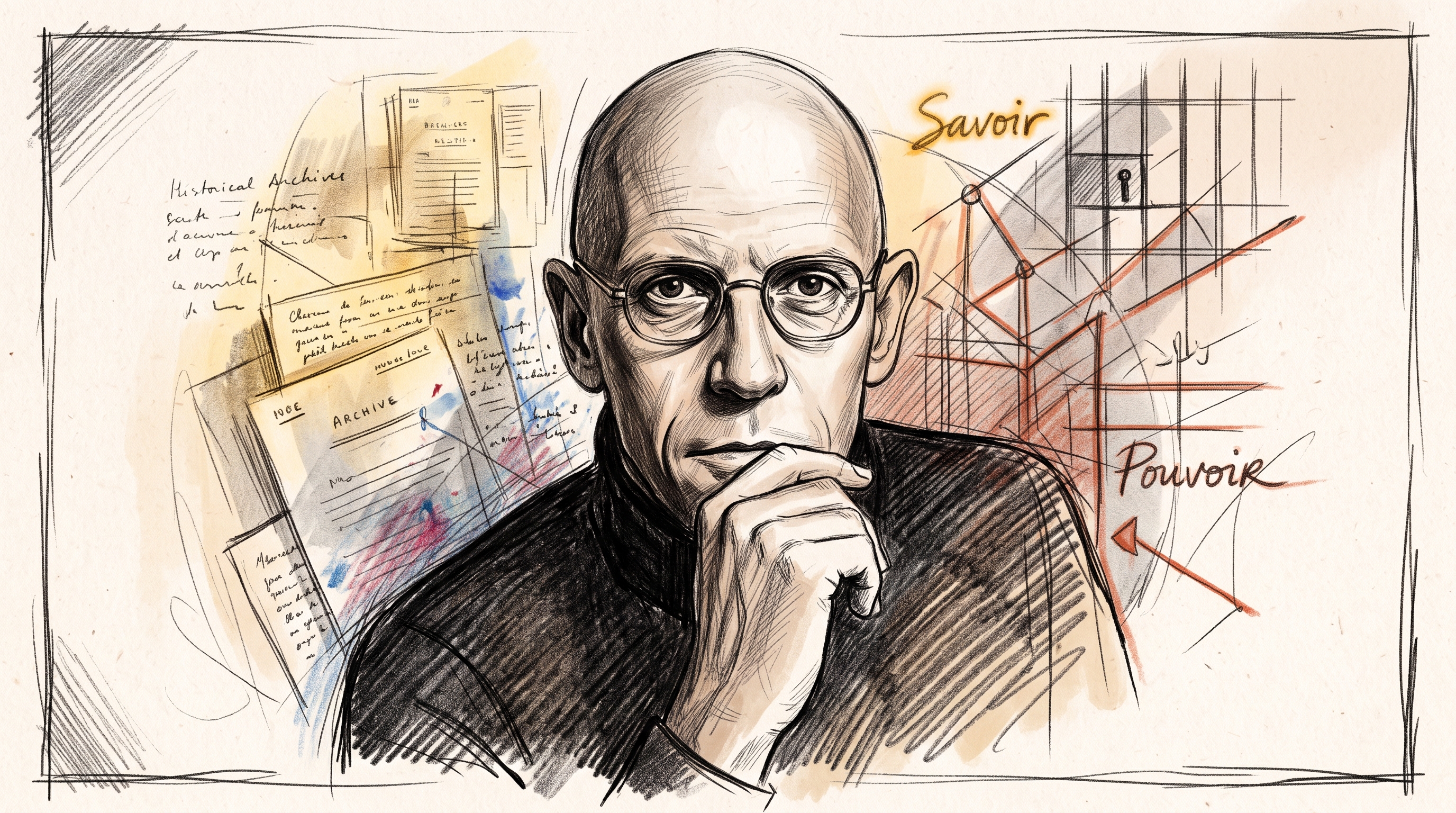
Michel Foucault stands as one of the most transformative critical theorists and historical philosophers of the twentieth century. His scholarship dismantles the Enlightenment myth of linear human progress and emancipatory reason, demonstrating instead that systems of knowledge (savoir) are fundamentally inseparable from apparatuses of social power (pouvoir). Spanning three major methodological phases—Archaeology (unearthing the historical a priori and discursive rules governing thought), Genealogy (analyzing how carceral institutions and biopolitical technologies mold the human body and manage populations), and Ethics (interrogating the "technologies of the self," governmentality, and the aesthetics of existence)—Foucault radically redefined modern understandings of the clinic, the asylum, the prison, sexuality, and the state. His work traces how modern power operates not through overt sovereign terror, but through pervasive, capillary networks that internalize surveillance, produce "docile bodies," and manufacture the very subjectivity of the modern individual.
1. Methodological Trajectory: Archaeology, Genealogy, and Ethics
Foucault’s intellectual output is structured across three distinct yet organically continuous methodological phases. Rather than viewing history as an unbroken, teleological march toward enlightenment, Foucault approached historical epochs as discontinuous formations characterized by epistemic fractures, contingent power struggles, and shifting modes of subjectivation.[1]
[ ARCHAEOLOGY ]  ──►  [ GENEALOGY ]  ──►  [ ETHICS / TECHNOLOGIES OF SELF ]
Epistemic Formations     Power/Knowledge Networks     Aesthetics of Existence & Parrhesia
Rules of Discourse       Anatomo- & Biopolitics       The Governance of Self & Others
(1960s: Order of Things) (1970s: Discipline/History)  (1980s: Collège de France Lectures)
The table below delineates the architectural progression across Foucault's major methodological epochs:
| Analytical Epoch | Primary Method | Epistemological Focus | Central Diagnostic Question | Canonical Texts | Conception of the Subject |
|---|---|---|---|---|---|
| Early Phase (1960s) | Archaeology | Discursive formations, historical a priori, epistemic thresholds. | "What historical conditions make specific forms of knowledge and truth claims possible?" | The Birth of the Clinic (1963), The Order of Things (1966), The Archaeology of Knowledge (1969) | The subject as an effect of discursive rules; "Man" as an ephemeral historical invention. |
| Middle Phase (1970s) | Genealogy | Power-knowledge (pouvoir-savoir), institutional mechanics, carceral discipline, biopolitics. | "How do physical bodies become disciplined, classified, and regulated through networks of power and surveillance?" | Discipline and Punish (1975), The History of Sexuality, Vol. 1 (1976), Society Must Be Defended (1976) | The "docile body" (corps docile); the individual manufactured as both object and instrument of power. |
| Late Phase (1980s) | Ethics & Governmentality | Technologies of the self (technologies de soi), pastoral power, biopolitical statecraft, fearless speech (parrhesia). | "How does the individual actively fashion their own ethical identity, and how are populations governed through freedom?" | The Use of Pleasure (1984), The Care of the Self (1984), Security, Territory, Population (1978), The Birth of Biopolitics (1979) | The self-fashioning agent; subjectivity constituted through reflective practices of freedom and resistance. |
Intellectual Influences and Epistemological Roots
To understand Foucault's methodologies, it is necessary to trace the intellectual genealogy that informed his thought:
- Georges Canguilhem and Gaston Bachelard: Foucault inherited the concept of "epistemological breaks" (ruptures épistémologiques) from these French historical epistemologists. They argued that scientific knowledge does not advance through a smooth, cumulative accumulation of facts, but through radical conceptual discontinuities and institutional reorganizations. This insight provided the blueprint for Foucault's archaeological method.[2]
- Friedrich Nietzsche: Nietzsche’s influence remains the indispensable cornerstone of Foucault’s genealogy. From On the Genealogy of Morals, Foucault adopted the critical practice of exposing the violent, contingent, and interest-laden origins of cultural values that society reveres as universal or timeless truths. Reason, morality, and justice are not transcendent metaphysical categories; they are the historical trophies of victors in ongoing struggles for domination.[1:1]
- Immanuel Kant: Foucault situated his enterprise as a radicalized continuation of the Kantian critical tradition. Whereas Kant formulated the critique of pure reason by inquiring into the universal limits of the human mind ("What are the necessary conditions of possible experience?"), Foucault historicized Kant’s question: "In what is given to us as universal, necessary, and obligatory, what part is actually singular, contingent, and the product of arbitrary constraints?" Critique, for Foucault, becomes "the art of not being governed quite so much."[3]
- Karl Marx: While fiercely critical of dogmatic Marxism and its economic determinism, Foucault incorporated the materialist insight that knowledge and institutional apparatuses are embedded in physical practices. However, Foucault decentralized the Marxist conception of power, arguing that power cannot be reduced to a possession of the ruling class or an epiphenomenon of the economic base.
2. The Archaeology of Knowledge and the Historical Episteme
During his archaeological period in the 1960s, Foucault investigated the unconscious, structural rules that govern human communication and scientific taxonomy across different historical eras. He introduced the concept of the episteme (épistémè)—the total set of unconscious relations and structural conditions that unite the discursive practices of a given epoch.[4]
The Sequence of Western Epistemes
In The Order of Things: An Archaeology of the Human Sciences (1966), Foucault identified three fundamental epistemic shifts in Western civilization since the Renaissance:
| Epistemic Epoch | Historical Period | Organizing Principle | Semiotic Relationship (Sign & Thing) | Dominant Modes of Knowledge | Foundational Rupture / Characteristic Work |
|---|---|---|---|---|---|
| Renaissance Episteme | 16th Century | Resemblance & Similitude (Convenientia, Aemulatio, Analogy, Sympathy) | The sign and the world are woven together; language is an intrinsic signature inscribed on the cosmos. | Hermeneutics, natural magic, divination, signature doctrine. | Nature read as a sacred scripture; Paracelsus, Aldrovandi's natural histories. |
| Classical Episteme | Mid-17th to Late-18th Century | Representation, Order & Mathesis | Separation of sign and world; language functions as a transparent, neutral grid representing thought. | General grammar, natural history (Linnaean taxonomy), analysis of wealth (mercantilism). | The encyclopedic table; Diego Velázquez’s Las Meninas; Descartes’ Regulae. |
| Modern Episteme | 19th to Mid-20th Century | Historicity, Organic Internal Organization & "Man" | Language becomes an autonomous historical object; things possess internal development and historical density. | Evolutionary biology (Cuvier, Darwin), historical philology (Bopp), political economy (Ricardo, Marx). | The emergence of the human sciences; Kantian transcendental critique; discovery of human finitude. |
| Contemporary / Post-Structural Episteme | Late 20th Century to Present | Cybernetics, Informational Dispersal & The Dividual | The linguistic sign dissolves into self-referential digital codes and simulation; the unified human subject dissolves. | Molecular genetics, cognitive informatics, algorithmic networks, post-humanism. | The "Death of Man"; Postscript on the Societies of Control; Jean Baudrillard's Defining a Simulacrum. |
Velázquez’s Las Meninas and the "Death of Man"
Foucault opens The Order of Things with an analysis of Diego Velázquez's 1656 masterwork Las Meninas. For Foucault, this painting operates as the visual manifesto of the Classical episteme:[4:1]
- The Missing Center: Velázquez depicts the painter himself looking out from the canvas, the young Infanta Margarita surrounded by attendants, and a mirror in the distant background reflecting the Spanish monarchs, King Philip IV and Queen Mariana. The actual subject of the portrait—the royal couple, and by extension the spectator standing in their place—is structurally absent from the picture plane, existing only as a reflected virtuality in the mirror.
- Representation Representing Itself: The painting portrays all the elements of representation (the painter, the canvas, the light, the models, the spectator), yet the unified observing consciousness that organizes this representation remains elusive.
- The Modern Invention and Eventual "Death of Man": Foucault's most provocative thesis is that "Man" as an object of scientific knowledge did not exist prior to the late eighteenth century. Before the modern episteme, human beings were observers within a divine taxonomy, not a sovereign subject-object of empirical study. With the rise of modern biology, economics, and linguistics, "Man" was constructed as a bizarre, double-faced entity: a finite biological organism conditioned by history, yet simultaneously the transcendental source of all knowledge. Foucault concludes that as language reasserts its autonomous materiality, this fragile conceptual construct will vanish:
"As the archaeology of our thought easily shows, man is an invention of recent date. And one perhaps nearing its end. If those arrangements were to disappear as they appeared... then one can certainly wager that man would be erased, like a face drawn in sand at the edge of the sea." — Michel Foucault, The Order of Things (1966)[4:2]
Semiotic Rupture and René Magritte
Foucault extended his archaeological analysis of representation in his 1973 treatise Ceci n'est pas une pipe (This is Not a Pipe), engaging the Surrealist artist René Magritte. Magritte's famous painting The Treachery of Images (1929) juxtaposes a photorealistic image of a smoker's pipe with the painted statement: "Ceci n'est pas une pipe." Foucault demonstrates that Magritte systematically detonates the Classical episteme's presumption of transparent representation:
- The painted pipe is not a physical pipe (one cannot fill or smoke it); it is merely painted canvas.
- The linguistic sentence is not a pipe; it is an arrangement of orthographic signs.
- The word "ceci" (this) is radically ambiguous: does it refer to the painting above, the canvas itself, or the sentence of which it is part?
- Magritte breaks the unwritten agreement of Western art that united linguistic naming with plastic similitude, prefiguring post-structuralist critiques of language and the collapse of stable signification.[5]
3. The Genealogy of Power: From Sovereign Terror to Disciplinary Enclosure
In the 1970s, Foucault turned from discursive structures to the physical realities of institutional violence, corporal punishment, and surveillance. In Discipline and Punish: The Birth of the Prison (1975), he mapped a fundamental transformation in the mechanics of Western social control over three centuries.[6]
The Historical Transformation of Punishment
Foucault contrasts two radically different penal spectacles to illustrate the death of sovereign power and the birth of disciplinary society:
- The Sovereign Execution of Robert-François Damiens (1757): Damiens, who attempted regicide against Louis XV, was subjected to unspeakable public torture in Paris. His flesh was torn with red-hot pincers, melted lead and boiling oil were poured into his wounds, his body was dismembered by four draught horses, and his remains were burned to ashes. In the sovereign paradigm, crime is an act of direct personal treason against the monarch's body. Punishment must take the form of an asymmetric, theatrical spectacle of physical agony (l'éclat des supplices), publicly re-establishing the absolute majesty and wrath of the sovereign.[6:1]
- The Disciplinary Timetable of Léon Faucher (1838): Less than a century later, public torture was replaced by the silent, rigid routine of the Young Prisoners' Institution in Paris. Every minute of the convict's day was partitioned into an exact schedule: rising at 5:00 AM, mechanical prayer, ten hours of silent industrial labor, synchronized meals, and compulsory moral instruction. The target of penal power had shifted from the physical destruction of the body to the psychological and moral reformation of the soul.[6:2]
The Mechanics of Disciplinary Power
Disciplinary power does not smash the body through violent excess; it meticulously breaks it down, trains it, and reassembles it to maximize both its economic utility and its political obedience. Foucault identified three primary instruments of discipline:
- Hierarchical Observation: The architectural organization of space to allow uninterrupted, one-way surveillance. Visibility becomes a trap.
- Normalizing Judgment: The establishment of an arbitrary standard of "normal" behavior. Every deviation (sloth, disrespect, insolence, irregularity) is recorded, graded, and subjected to micro-penalties and remedial retraining.
- The Examination: The ultimate synthesis of surveillance and normalization. The examination objectifies individuals into legible cases, documentation files, and permanent statistical archives.
The Panopticon as Political Technology
To encapsulate the logic of disciplinary society, Foucault seized upon the architectural design of the Panopticon, conceived by English utilitarian philosopher Jeremy Bentham in 1787.
               [ PERIPHERAL RING: ISOLATED PRISON CELLS ]
               ┌───────────────────────────────────────┐
               │  [Cell]   [Cell]   [Cell]   [Cell]    │
               │                                       │
               │             ┌───────────┐             │
               │             │  CENTRAL  │             │
               │             │SURVEILLANCE│            │
               │             │   TOWER   │             │
               │             └───────────┘             │
               │                                       │
               │  [Cell]   [Cell]   [Cell]   [Cell]    │
               └───────────────────────────────────────┘
The Panopticon consists of an annular building with individual, backlit cells around the perimeter and a central inspection tower in the middle. Blinds and zigzag partitions prevent the inmates from seeing whether a guard is inside the tower.
| Panoptic Dimension | Architectural / Functional Implementation | Sociological & Psychological Consequence |
|---|---|---|
| Pervasive Asymmetry | The guard can observe every prisoner at any second; the prisoner can never look back or confirm the guard's presence. | Dissolves the need for physical force; power operates automatically and effortlessly. |
| Internalization of the Gaze | Because the inmate never knows when they are being watched, they must assume they are being watched at all times. | The subject becomes their own jailer; external coercion is converted into self-surveillance. |
| Separation & Spatial Isolation | Inmates are physically partitioned; no lateral communication or collective congregation is permitted. | Destroys the possibility of collective rebellion, mutual conspiracy, or crowd solidarity. |
| Universal Portability | The panoptic model is not restricted to prisons; it serves as an architectural template for schools, factories, hospitals, and barracks. | Generalizes the disciplinary apparatus throughout the entire social body: the "carceral archipelago." |
"He who is subjected to a field of visibility, and who knows it, assumes responsibility for the constraints of power; he makes them play spontaneously upon himself; he inscribes in himself the power relation in which he simultaneously plays both roles; he becomes the principle of his own subjection." — Michel Foucault, Discipline and Punish (1975)[6:3]
Capillary Power and the Power-Knowledge Nexus (Pouvoir-Savoir)
Foucault rejected the traditional "repressive hypothesis," which conceptualizes power solely as a negative, prohibitive force wielded by a centralized state or monarch shouting "Thou shalt not." Power is not merely prohibitive; power is productive (pouvoir productif):
- Capillary Action: Power does not radiate exclusively from top to bottom; it operates like a network of capillaries permeating the entire social fabric, running through the family, medicine, education, sexuality, and daily language.
- Productive Mechanics: Power produces reality; it produces domains of objects, rituals of truth, and categories of identity. It produces the "delinquent," the "pervert," the "hysteric," and the "good student."
- The Power-Knowledge Matrix (Pouvoir-Savoir): Power and knowledge directly imply one another. There is no power relation without the correlative constitution of a field of knowledge, and no knowledge that does not simultaneously presuppose and constitute power relations. Modern scientific discourses (psychiatry, criminology, sociology) did not emerge independently of power; they were forged as the administrative tools required to manage, classify, and master human populations.[7]
4. Biopolitics, Security Mechanisms, and Governmentality
In the mid-to-late 1970s, Foucault expanded his investigation from micro-institutions of discipline to the macro-management of entire human populations. In The History of Sexuality, Volume 1 (1976) and his Collège de France lecture courses—Security, Territory, Population (1977–1978) and The Birth of Biopolitics (1978–1979)—he introduced the concepts of biopower, biopolitics, and governmentality.[7:1][8]
                       [ HISTORICAL MODALITIES OF POWER ]
                                        │
         ┌──────────────────────────────┼──────────────────────────────┐
         ▼                              ▼                              ▼
[ SOVEREIGN POWER ]            [ DISCIPLINARY POWER ]          [ BIOPOLITICAL SECURITY ]
• Target: Territory & Law      • Target: Anatomical Body       • Target: Species Population
• Instrument: Violent Sword    • Instrument: Panoptic Enclosure • Instrument: Statistics & Risk
• "Take life or let live"      • "Make live and let die"       • "Optimize life & regulate death"
The table below contrasts the three fundamental modalities of power analyzed across Foucault's work:
| Comparative Dimension | Sovereign Power (16th–17th Century) | Disciplinary Power (18th–19th Century) | Biopolitical Security (Late 19th Century–Present) |
|---|---|---|---|
| Primary Target | Territory, physical borders, dynastic allegiance. | The individual anatomical body (anatomo-politics). | The collective biological population as a species (biopolitics). |
| Sovereign Formula | Faire mourir et laisser vivre ("To make die and to let live"). | Faire vivre et laisser mourir ("To make live and to let die"). | Réguler la vie et gérer la mort ("To optimize biological life and manage demographic risk"). |
| Operative Instrument | Public torture, the executioner's sword, monarchical decrees. | Timetables, physical drills, spatial confinement, the panopticon. | Actuarial tables, epidemiological tracking, birth/fertility rates, public hygiene. |
| Spatial Architecture | Feudal realm, the palace courtyard, public scaffold. | Closed enclosures: the prison, the factory, the school, the barracks. | Open circulations: urban highway networks, global markets, public health conduits. |
| Management Logic | Absolute prohibition: binary division of the permitted and forbidden. | Micro-prescription: exhaustively directing every posture and second of time. | Probabilistic modulation: calculating acceptable bandwidths of crime, illness, and economic flux. |
| Vault Conceptual Resonance | The sovereign tyrant of feudal history. | William H. Whyte's The Organization Man; Franz Kafka (1883-1924). | Shoshana Zuboff-The Age of Surveillance Capitalism; Postscript on the Societies of Control. |
Defining Governmentality (Gouvernementalité)
Foucault coined the term governmentality as a portmanteau of governmental and rationality. It designates the historical emergence of a distinct "art of government" that transcends the direct administrative command of the state:[8:1]
- Pastoral Power: Modern secular statecraft inherited its operational logic from the early Christian pastorate. The Christian pastor was responsible for guiding each sheep individually while maintaining the health of the entire flock (omnes et singulatim—all and each). The modern welfare and security state secularizes pastoral power, claiming responsibility for the biological health, material security, and happiness of every individual citizen from cradle to grave.
- The Ensemble of the Apparatus (Dispositif): Governmentality operates through an intricate dispositif—a heterogeneous network comprising laws, administrative edicts, architecture, scientific doctrines, moral guidelines, and economic institutions designed to guide human behavior.
- Government as the "Conduct of Conducts": To govern is not to crush human agency; it is to structure the possible field of action of others (conduire des conduites). Power operates most effectively when subjects believe they are acting freely and autonomously while pursuing goals pre-structured by institutional rationalities.
Neoliberalism and the Enterprise of the Self
In his 1978–1979 lecture course The Birth of Biopolitics, Foucault delivered an analysis of German Ordoliberalism and the American Chicago School of Economics (Milton Friedman, Gary Becker). Foucault recognized that American neoliberalism was not merely an economic ideology advocating deregulation; it was an all-encompassing governmental rationality that transforms human subjectivity itself:[9]
- The Reinvention of Homo Economicus: In classical liberalism, homo economicus was a partner in economic exchange (the merchant or consumer). In neoliberalism, homo economicus is reinvented as an entrepreneur of himself (entrepreneur de soi-même).
- Human Capital Theory: Following Gary Becker, every human capacity—education, physical health, psychological resilience, emotional intelligence, genetic fitness, and social network connections—is reframed as "human capital" that the individual must continuously manage, optimize, and monetize.
- The Marketization of the Social: The economic matrix of investment, risk management, and cost-benefit optimization is extended into non-economic domains: dating, family life, artistic creation, and personal ethics. The subject is disciplined not by an authoritarian warden, but by the internalized imperative to maintain market competitive value.
The Trajectory to Deleuze’s Society of Control
Foucault’s transition from disciplinary enclosures to open biopolitical security apparatuses directly anticipated Gilles Deleuze's landmark essay, Postscript on the Societies of Control. Deleuze noted that Foucault was the first to recognize that disciplinary enclosures (factories, schools, asylums) were already entering a state of terminal crisis by the mid-twentieth century:[10]
| Dimension | Disciplinary Society (Foucault) | Society of Control (Deleuze) | Surveillance Capitalism (Zuboff) |
|---|---|---|---|
| Operative Space | Rigid physical enclosure (factory, prison, school). | Open, fluid networks; universal remote access. | Ubiquitous digital sensor networks, predictive platforms. |
| Core Technology | Mechanical, thermodynamic machines (steam, assembly lines). | Cybernetic computers, algorithms, digital telecommunications. | Big data architectures, behavioural futures markets, AI models. |
| Target of Molding | The individual body molded into a uniform casting (moulage). | Continuous digital modulation; self-deforming sieves (modulation). | Behavioral surplus harvested to modify real-time action. |
| Human Unit | Individual & Mass (signature and employee registration number). | Dividual (data fragments, behavioral samples, bank PINs). | Behavioral profile, digital exhaust, automated risk score. |
| Institutional Emblem | The Prison / The Panopticon. | The Corporation / The Network Grid. | The Platform Monopoly (Google, Meta, Amazon). |
5. Subjectivity, Technologies of the Self, and Parrhesia
In the final phase of his life, Foucault shifted his focus from the mechanisms of external subjugation to the historical techniques by which individuals constitute themselves as ethical subjects. Disturbed that his middle works had been misinterpreted as depicting human beings as passive pawns of omnipotent power systems, Foucault turned to Classical Greece, Hellenistic Rome, and early Christian monasticism in The Use of Pleasure (1984) and The Care of the Self (1984).[11]
Assujettissement (The Paradox of Subjectivation)
Foucault emphasized the linguistic duality embedded in the French noun assujettissement:
- Subjection: Being made subordinate to external authority, social norms, and institutional surveillance.
- Subjectivation: Becoming a conscious, self-aware subject endowed with an identity, a conscience, and agency.
Power does not merely oppress an already existing human subject; power is the very condition that calls the subject into existence. One becomes an active human subject precisely by submitting to the linguistic, moral, and cultural categories provided by one's historical epoch.[12]
Foucault’s Four Technologies of Human Formation
Foucault established a four-part taxonomy of the practical techniques by which human societies construct knowledge and subjectivity:
| Technology Type | Primary Operational Field | Methodological Objective | Historical / Institutional Examples |
|---|---|---|---|
| Technologies of Production | Physical matter, nature, commodities. | Allows humans to produce, transform, or manipulate physical objects. | Agriculture, metallurgy, mechanized industrial manufacturing, software coding. |
| Technologies of Sign Systems | Language, semiotics, symbols, culture. | Allows humans to deploy signs, meanings, symbols, and linguistic significations. | Grammars, hermeneutics, rhetoric, advertising branding, media broadcasts. |
| Technologies of Power | Social behavior, institutions, populations. | Determines the conduct of individuals and submits them to certain ends or domination. | The carceral system, military drills, educational curricula, corporate management. |
| Technologies of the Self | The individual's soul, body, thoughts, desires. | Permits individuals to effect operations on their own bodies, thoughts, and conduct to attain happiness, purity, wisdom, or perfection. | Meditative journaling (hypomnemata), stoic contemplation of death, confession, ascetics. |
The Care of the Self (Epimeleia Heautou) and the Aesthetics of Existence
Foucault discovered that in Greco-Roman antiquity, the foundational ethical imperative was not the Delphic oracle's "Know thyself" (gnōthi seauton), but rather "Care for thyself" (epimeleia heautou):[11:1]
- Self-Care as a Precondition for Governance: In ancient Athens and Rome, mastership of oneself (enkrateia) was the mandatory prerequisite for exercising power over others. One who could not govern their own bodily desires, spending, and temper could not be trusted to govern a city or lead a family.
- The Practice of Hypomnemata: Educated Greeks and Romans kept personalized notebooks called hypomnemata, recording aphorisms, philosophical arguments, dietary observations, and personal reflections to be consulted during moments of ethical crisis. Writing functioned as an ascetical technology for assimilating external wisdom into an internal psychological fortress.
- An Aesthetics of Existence: In the modern post-Nietzschean era—where universal religious dogma, theological teleology, and scientific moralisms have collapsed—Foucault argued that human beings must cultivate an "aesthetics of existence." Rather than searching for a hidden, essential "true self" to uncover through psychological confession, the modern individual must approach their own life as a deliberate work of art, actively styling their desires, actions, and intellectual commitments.[11:2]
Parrhesia (Fearless Speech)
In his final lecture courses at the Collège de France (The Courage of Truth, 1983–1984), Foucault investigated the ancient Greek practice of parrhesia (parrhēsia—fearless speech or frankness):[13]
- The Structural Conditions of Parrhesia: A speaker engages in parrhesia only when:
- They state the unvarnished, authentic truth without rhetorical flattery or obfuscation.
- The truth spoken challenges or offends a more powerful interlocutor (e.g., the citizen confronting the tyrant, the philosopher confronting the king).
- Speaking this truth incurs severe personal risk, including exile, imprisonment, or death.
- The Ethical Core of Resistance: Parrhesia represents Foucault's answer to the problem of political resistance. Resistance does not depend on utopian grand narratives or violent messianism; it resides in the ethical courage of the autonomous individual who risks everything to speak the truth to power, exposing the arbitrariness of reigning regimes of truth.[13:1]
6. Interdisciplinary Legacy and Theoretical Influence
Foucault's conceptual lexicon altered the intellectual topography of the humanities and social sciences across the globe.
| Academic Discipline / Field | Key Intellectual Successor | Foundational Text | Foucauldian Conceptual Inheritance |
|---|---|---|---|
| Queer Theory & Feminist Philosophy | Judith Butler | Gender Trouble: Feminism and the Subversion of Identity (1990) | Deconstruction of biological essentialism; sex and gender analyzed as discursive constructions and regulatory bodily performances. |
| Post-Colonial Studies | Edward Said | Orientalism (1978) | Applying the power-knowledge matrix to imperial geography; demonstrating how the West discursively invented "the Orient" to legitimize colonial dominance. |
| Post-Marxist State Theory | Giorgio Agamben | Homo Sacer: Sovereign Power and Bare Life (1995) | Fusing Foucault's biopolitics with Carl Schmitt's state of exception; analyzing the concentration camp as the pure biopolitical paradigm of the modern state. |
| Critical Prison Studies | Angela Y. Davis | Are Prisons Obsolete? (2003) | Mobilizing the analysis of the carceral archipelago to critique mass incarceration and the contemporary prison-industrial complex. |
| Platform Studies & Digital Surveillance | Shoshana Zuboff | The Age of Surveillance Capitalism (2019) | Evolving the Panopticon into the "Big Other"; automated behavioral modification replacing physical institutional enclosures. |
| Control Society Theory | Gilles Deleuze | Postscript on the Societies of Control (1990) | The migration of disciplinary confinement into continuous digital modulation, coded access, and the birth of the Dividual. |
🎴 Interactive Web Practice (Comprehension Check)
Question 1 (Archaeology vs. Genealogy & The Episteme): How does Foucault's genealogical method differ from his earlier archaeological approach, and how does the concept of the episteme in The Order of Things overturn traditional Enlightenment historiography?
Answer: While Foucault's archaeological method (dominant in the 1960s) focused on excavating the unconscious, structural rules of discourse and the conditions that allow statements to emerge as valid knowledge within a given historical epoch (the episteme), it remained relatively static and descriptive. In contrast, his genealogical method (adopted in the 1970s under the influence of Nietzsche) introduces dynamic historical conflict, bodily materialization, and the power-knowledge matrix. Genealogy investigates how institutions, carceral disciplines, and regimes of truth are forged through violent struggles, historical contingencies, and non-teleological descent.
The concept of the episteme overturns Enlightenment historiography by rejecting the myth of linear intellectual progress. History does not represent the continuous, triumphant accumulation of reason toward truth; instead, it is punctuated by radical epistemic ruptures (Renaissance, Classical, Modern) where the foundational rules governing signification, taxonomy, and truth undergo sudden, discontinuous shifts.
Question 2 (The Panopticon & Capillary Power): Why does Foucault regard Jeremy Bentham's Panopticon as the architectural blueprint for modern disciplinary power, and how does this model illustrate that power is productive rather than merely repressive?
Answer: Foucault identifies Bentham's Panopticon as the ideal architectural technology of disciplinary power because it produces the conscious and permanent visibility of the inmate, assuring the automatic functioning of power. Because the prisoner can see the central inspection tower but can never verify whether a guard is watching, the physical enforcement of power is rendered obsolete: the inmate internalizes the surveillance gaze and becomes the principle of their own subjection.
This mechanism illustrates that modern power is fundamentally productive (pouvoir productif) rather than merely repressive. Instead of acting as an external, sovereign force that violently suppresses an individual's pre-existing desires through the threat of death ("Thou shalt not"), disciplinary power meticulously shapes, measures, trains, and optimizes the body. It manufactures "docile bodies," produces institutional norms, establishes classifications of knowledge (such as criminality, sanity, and sexual orientation), and builds the psychological subjectivity of the modern individual.
Question 3 (Biopolitics, Governmentality & Neoliberal Subjectivity): In what ways does biopolitics mark a historical departure from sovereign power, and how does neoliberal governmentality transform homo economicus into an "entrepreneur of the self"?
Answer: Sovereign power operated under the formula faire mourir et laisser vivre ("to make die and let live"), asserting its authority through the violent spectacle of public execution and the right to seize territory, goods, and lives. In contrast, biopower inverts this logic into faire vivre et laisser mourir ("to make live and let die"). It directs its attention to the collective biological population as a species, managing birth rates, mortality, longevity, public health, and epidemic risk through actuarial statistics and security mechanisms.
In his lectures on neoliberal governmentality (The Birth of Biopolitics), Foucault shows that the art of government shifts from state legal prohibitions to structuring the conditions under which free individuals choose to act. Neoliberalism radically reconfigures the classical homo economicus: rather than remaining an external partner in market exchange, the individual is reconceived as an "entrepreneur of the self" who possesses "human capital." The subject is governed by internalizing market rationality, constantly optimizing their health, education, emotional resilience, and productivity to maintain personal competitive value in an open market environment.
Question 4 (Assujettissement, Care of the Self & Parrhesia): Explain the dual meaning of assujettissement in Foucault's late scholarship, and describe how Hellenistic "technologies of the self" and parrhesia provide pathways for ethical resistance against institutional discipline.
Answer: Foucault highlights the paradoxical double meaning embedded in the French word assujettissement: it denotes both subjection (being dominated, disciplined, and constrained by external institutional apparatuses) and subjectivation (becoming a conscious, self-reflective subject endowed with agency, identity, and moral conscience). Crucially, for Foucault, the individual is not an autonomous entity that pre-exists power; human subjectivity is constituted precisely through the process of submitting to historical discourses and social norms.
To resist being entirely colonized by disciplinary normalization and state biopolitics, Foucault turned to Greco-Roman antiquity to analyze "technologies of the self." Through the "care of the self" (epimeleia heautou), journaling (hypomnemata), meditation, and ascetics, individuals can actively mold their own lives into an "aesthetics of existence" rather than passively conforming to normalized identities. Furthermore, through parrhesia (fearless, frank speech), the ethical subject undertakes the personal risk of speaking unvarnished truth to power, directly challenging corrupt authorities and exposing the arbitrary constraints of reigning regimes of truth.
Resonant Notes
The following notes in the vault share direct thematic, sociological, and literary connections with Michel Foucault:
🔴 Surveillance, Discipline & Social Control
- Postscript on the Societies of Control — Gilles Deleuze’s seminal essay directly extends Foucault's critique of disciplinary societies into the late-twentieth-century paradigm of control societies, illustrating how the physical enclosures of prisons, factories, and schools have dissolved into continuous digital modulation and algorithmic tracking.
- Dividual — Traces the sociological trajectory from Foucault’s cohesive disciplinary individual (governed by signature and identification number) to Deleuze’s fragmented "dividual," reduced to divisible data points and consumer behavioral samples.
- The Dividual and the Triṃśikā — Bridges Foucault’s disciplinary subjectivation and Deleuze’s dividual with Buddhist Yogācāra psychology, demonstrating how algorithmic surveillance and identity construction technologically externalize psychological fragmentation.
- Shoshana Zuboff-The Age of Surveillance Capitalism — Extends Foucault's panoptic paradigm into the digital economy, showing how private tech conglomerates extract behavioral surplus to engineer predictive architectures of influence, replacing state confinement with automated behavioral modification.
- George Orwell (1903-1950) — Orwell’s Nineteen Eighty-Four depicts the ultimate literary nightmare of the Panopticon; where Foucault analyzed the structural internalization of the gaze, Orwell dramatized its totalitarian weaponization through the Thought Police and inescapable telescreens.
- Don DeLillo Major Themes Analysis — DeLillo explores the contemporary successor to Foucault's disciplinary surveillance; in novels like White Noise and Mao II, corporate marketing codes, supermarket scanners, and televisual saturation manufacture voluntary self-discipline and ideological conformity.
- Franz Kafka (1883-1924) — Kafka’s surreal institutional nightmares in The Trial and In the Penal Colony prefigure Foucault’s carceral archipelago, illustrating how anonymous bureaucratic apparatuses execute sovereign violence through opaque legal disciplines that render the subject perpetually guilty.
- William H. Whyte's The Organization Man & William H. Whyte's Social Ethics — Whyte’s mid-century corporate conformist demonstrates Foucault's disciplinary normalization, where corporate management uses psychological testing to manufacture docile corporate employees.
🟡 Discourse, Power-Knowledge & Epistemic Regimes
- Continental Philosophy — Situates Foucault within the broader French post-structuralist and post-Marxist movement alongside Jacques Derrida, Gilles Deleuze, and Louis Althusser, mapping his epistemological break from existentialism and Hegelian phenomenology.
- Friedrich Nietzsche — Nietzsche’s On the Genealogy of Morals serves as the explicit philosophical ancestor of Foucault's genealogical method, providing the analytical blueprint for exposing how moral values and scientific truths are products of historical violence and will to power.
- René Magritte — Foucault’s monograph Ceci n'est pas une pipe unpacks Magritte's The Treachery of Images, demonstrating how the Belgian Surrealist severed the classical link between linguistic signification and plastic representation.
- The Social Construction of Reality - A Treatise in the Sociology of Knowledge — Peter L. Berger and Thomas Luckmann’s sociological treatise on institutionalization and reification complements Foucault’s archaeology, showing how social conventions achieve the status of objective, taken-for-granted realities.
- Jürgen Habermas's The Structural Transformation of the Public Sphere — Habermas offers a critical liberal foil to Foucault; where Habermas envisions a communicative space oriented toward rational consensus, Foucault insists that all discourse is inextricably shot through with asymmetric power relations.
- Edward Bernays' seminal 1928 work, Propaganda & Walter Lippmann's Public Opinion (1922) — Lippmann’s "manufacture of consent" and Bernays’ public relations engineering provide concrete institutional examples of Foucault’s power-knowledge nexus, demonstrating how behavioral sciences are utilized to manage democratic populations.
- The Propaganda Model — Edward Herman and Noam Chomsky's media analysis operates as an empirical demonstration of Foucauldian discursive hegemony, mapping the structural filters that establish the bounds of acceptable political debate in liberal democracies.
- Walter Benjamin (1892–1940) & Walter Benjamin’s Theses on the Philosophy of History — Benjamin’s imperative to "brush history against the grain" directly prefigures Foucault’s archaeology of subjugated knowledges, refusing the victors' triumphal historical narratives.
🟢 Governmentality, Biopolitics & Subjectivation
- Aldous Huxley's Brave New World (1932) — Huxley’s World State anticipates Foucault’s biopolitics far more accurately than Orwell's Oceania; social control is achieved through biological pre-determination, pharmacological pacification (soma), and the optimization of human reproductive life rather than terror.
- Dystopian Counterpoints - Brave New World vs. Nineteen Eighty-Four — Examines the dialectic between Orwellian sovereign discipline (fear, pain, violent coercion) and Huxleyan biopolitical governmentality (pleasure, consumption, genetic regulation), mapping directly onto Foucault’s historical taxonomy of power.
- Capitalism and Schizophrenia — Gilles Deleuze and Félix Guattari’s radical analysis of desiring-production and social repression connects to Foucault’s critique of the psychoanalytic confessional apparatus in The History of Sexuality.
- Karl Marx - Economic and Philosophic Manuscripts of 1844 — Marx’s early analysis of alienation and species-being offers an essential comparative baseline; whereas Marx grounds alienation in capitalist property relations and economic labor, Foucault decentralizes domination across diffuse institutional techniques of subjectivation.
- David Émile Durkheim (1858–1917) — Durkheim’s sociology of collective representation and moral education contrasts with Foucault’s critical genealogy; where Durkheim views social discipline as a functional necessity for social cohesion, Foucault unmasks it as an instrument of asymmetric control.
- Georg Simmel (1858-1918) & The Metropolis and Mental Life — Simmel’s dissection of the blase attitude and the calculating intellect required by the modern money economy resonates with Foucault’s analysis of the disciplinary spatialization and intellectualization of modern urban life.
- Freedom from a Sociological Perspective — Explores the sociological paradox of autonomy and structural constraint, providing a macro-sociological framework for Foucault's concept of assujettissement (the subject constituted through subjection).
- Yuval Noah Harari — Harari's analysis of dataism, biochemical engineering, and algorithms in Homo Deus represents the contemporary zenith of Foucauldian biopower, wherein biological life merges with digital computation to create new castes of optimized human capital.
Backlinks
- Postscript on the Societies of Control — Explicitly frames Gilles Deleuze's transition from disciplinary societies of enclosure to open societies of control as a direct extension and modification of Foucault's institutional analyses.
- Dividual — Grounded in the historical evolution from Foucault's disciplinary subject to Deleuze's fragmented data points within modern informational networks.
- Shoshana Zuboff-The Age of Surveillance Capitalism — Analyzes the digital transformation of Foucault's panoptic gaze into ubiquitous computational behavioral modification architectures.
- Don DeLillo Major Themes Analysis — Connects Foucault’s panoptic surveillance to DeLillo’s portrayal of late consumer capitalism, supermarket barcodes, credit ratings, and televisual conformity.
- René Magritte — Incorporates Foucault’s seminal textual analysis in This is Not a Pipe (Ceci n'est pas une pipe), exploring the breakdown of classical representation and semiotic similitude.
- Walter Benjamin’s Theses on the Philosophy of History — Links Benjamin’s critique of historicist progress and "brushing history against the grain" with Foucault's archaeology of subjugated knowledges.
- Continental Philosophy — Positions Foucault at the apex of French post-structuralist thought alongside Derrida and Deleuze, chronicling the linguistic and institutional turns in 20th-century philosophy.
- Dystopian Counterpoints - Brave New World vs. Nineteen Eighty-Four — Maps Foucault’s contrast between sovereign power and biopolitical normalization onto the literary architectures of Orwell and Huxley.
- Consumer Behavior and the Architecture of Influence — Applies Foucault's concepts of disciplinary power and the "conduct of conducts" to neuromarketing, choice architecture, and modern retail environments.
- The Dividual and the Triṃśikā — Uses Foucault's theories of subjectivation to demonstrate how identity is an internalized institutional construct rather than an immutable metaphysical essence.
- Freedom from a Sociological Perspective — Directly draws upon Foucault’s definition of power as the structuring of the field of possible actions of free agents.
References
Gary Gutting and Johanna Oksala / Michel Foucault / Stanford Encyclopedia of Philosophy ↩︎ ↩︎
Mary Tiles / Bachelard: Science and Objectivity / Cambridge University Press ↩︎
Michel Foucault / What is Enlightenment? (Qu'est-ce que les Lumières?) in The Foucault Reader (ed. Paul Rabinow) / Pantheon Books ↩︎
Michel Foucault / The Order of Things: An Archaeology of the Human Sciences / Routledge ↩︎ ↩︎ ↩︎
Michel Foucault / This is Not a Pipe (trans. James Harkness) / University of California Press ↩︎
Michel Foucault / Discipline and Punish: The Birth of the Prison (trans. Alan Sheridan) / Vintage Books ↩︎ ↩︎ ↩︎ ↩︎
Michel Foucault / The History of Sexuality, Volume 1: An Introduction (trans. Robert Hurley) / Pantheon Books ↩︎ ↩︎
Michel Foucault / Security, Territory, Population: Lectures at the Collège de France 1977-1978 (ed. Michel Senellart, trans. Graham Burchell) / Palgrave Macmillan ↩︎ ↩︎
Michel Foucault / The Birth of Biopolitics: Lectures at the Collège de France 1978-1979 (ed. Michel Senellart, trans. Graham Burchell) / Palgrave Macmillan ↩︎
Gilles Deleuze / Postscript on the Societies of Control / October, Vol. 59 (Winter 1992), pp. 3-7 ↩︎
Michel Foucault / The Care of the Self: The History of Sexuality, Volume 3 (trans. Robert Hurley) / Vintage Books ↩︎ ↩︎ ↩︎
Michel Foucault / "The Subject and Power" in Michel Foucault: Beyond Structuralism and Hermeneutics (eds. Hubert L. Dreyfus and Paul Rabinow) / University of Chicago Press ↩︎
Michel Foucault / The Courage of Truth: The Government of Self and Others II, Lectures at the Collège de France 1983-1984 (trans. Graham Burchell) / Palgrave Macmillan ↩︎ ↩︎