Jokes and Their Relation to the Unconscious
🗂️ Interactive Notebook: Open Study Companion (Video Summary, Flashcards, Mind Map) ↗
Jokes and Their Relation to the Unconscious (German: Der Witz und seine Beziehung zum Unbewussten) is Sigmund Freud's foundational 1905 investigation into the psychodynamics of wit, the comic, and humor. Published concurrently with Three Essays on the Theory of Sexuality, the treatise bridges clinical depth psychology with aesthetics, linguistics, and sociology. Freud argues that jokes are not trivial linguistic amusements, but sophisticated psychological compromises: like dreams and neurotic symptoms, they exploit unconscious mechanisms—specifically condensation and displacement—to circumvent internal psychic censorship. By momentarily lifting repression, jokes liberate psychic energy that would otherwise be expended on instinctual suppression, discharging this surplus as the somatic pleasure of laughter within an indispensable triadic social dynamic.
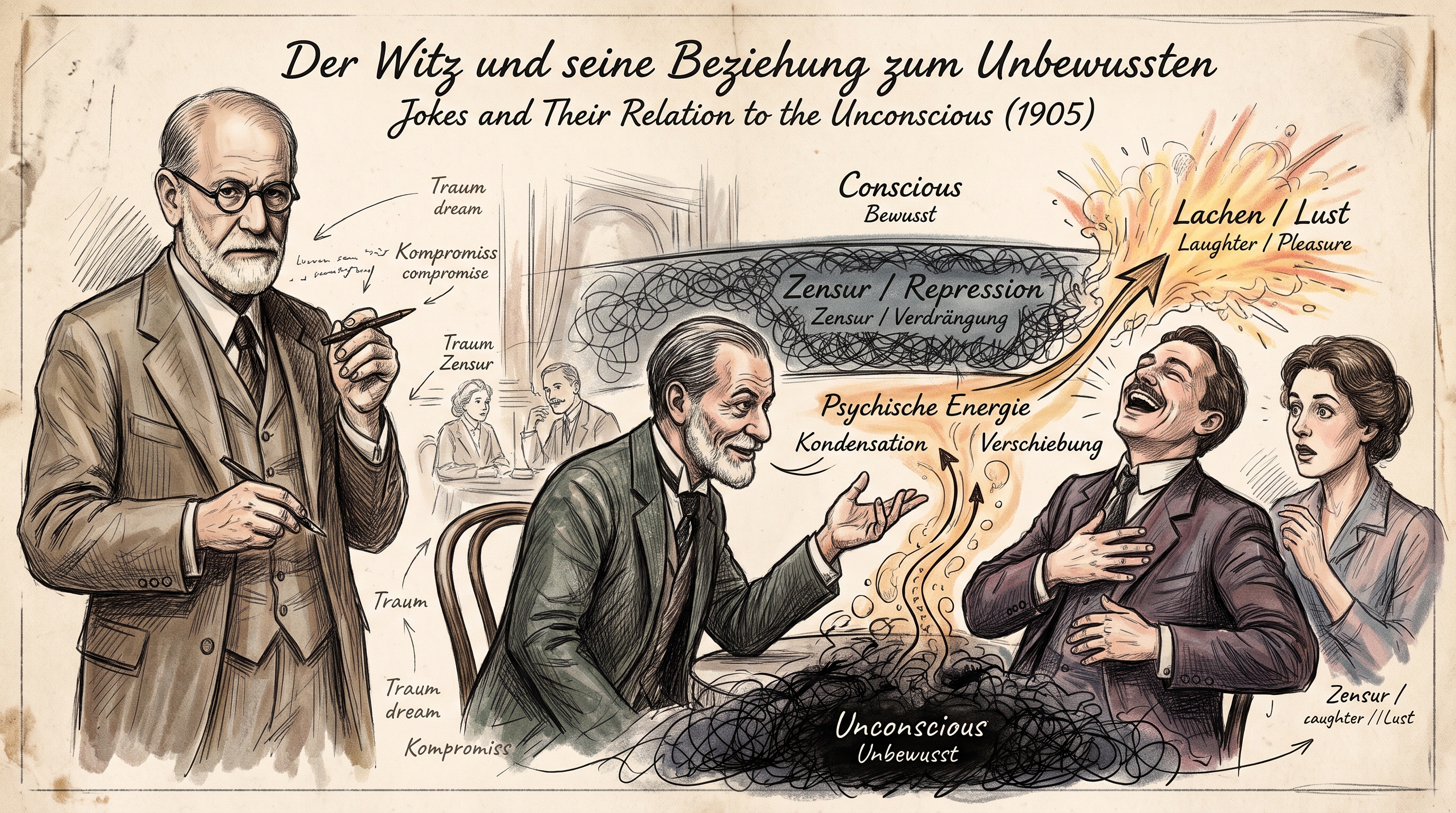
| Dynamic Stage | Structural Component | Manifestation & Mechanism |
|---|---|---|
| Repression Apparatus | Repressed Drives (Id) | Sexual impulses (libido), hostile and aggressive drives, anti-institutional cynicism |
| Internal Censorship (Ego / Superego) | Moral prohibitions, social decorum, and cultural norms requiring continuous counter-cathectic energy | |
| Joke-Work (Witzarbeit) | Techniques of Wit | Condensation (portmanteaus, composite words), displacement (diversion of focus), and double meaning (fore-pleasure) |
| Psychic Economy | Circumvention of Censorship | Short-circuits psychic inhibition without conscious guilt; suppression energy is suddenly rendered superfluous |
| Somatic Resolution | Motor Discharge: Laughter | Freed surplus energy is released along somatic pathways as explosive laughter, validated by the Third Person (Audience) |
1. Historical Context, Genesis, and Theoretical Trajectory
In 1897, while immersed in the self-analysis that yielded The Interpretation of Dreams (1899/1900), Freud observed in letters to Wilhelm Fliess that the bizarre logic of unconscious dream-work repeatedly mirrored the witty structures of Jewish folk jokes and Viennese cabaret humor.[1] Published in 1905, Jokes and Their Relation to the Unconscious represents Freud's systematic effort to expand psychoanalysis beyond individual psychopathology into everyday cultural and communicative phenomena.[2]
| Work | Year | Core Focus | Theoretical Contribution to Jokes |
|---|---|---|---|
| The Interpretation of Dreams (Die Traumdeutung) | 1900 | Unconscious primary processes (condensation, displacement) operating in individual isolation | Establishes the core unconscious mechanisms that Freud realizes also structure waking wit |
| Jokes and Their Relation to the Unconscious (Der Witz) | 1905 | Aesthetic, linguistic, and social compromise converting repressed drive into communicative pleasure | Connects unconscious technique with waking interpersonal communication and shared social euphoria |
| Three Essays on the Theory of Sexuality (Drei Abhandlungen) | 1905 | Instinctual drives (libido), infantile sexuality, erotogenic zones, and adult sublimation | Grounds the instinctual fuel (sexual, aggressive, and obscene) that powers tendentious humor |
While The Interpretation of Dreams analyzed how the unconscious hallucinates wish-fulfillments to protect individual sleep, Jokes examined how waking consciousness communicates taboo instinctual desires without provoking moral condemnation or social punishment.[3] Written concurrently with Three Essays on the Theory of Sexuality (1905), the text grounds humor directly in instinctual dynamics, illustrating how civilization forces the repression of sexuality and aggression, which then reemerge through linguistic artifice.[4]
2. The Economic Principle: The Hydraulic Model of Psychic Energy
At the core of Freud's psychoanalytic metapsychology lies an economic hypothesis: the human mind operates as an energy system governed by the conservation and quantitative distribution of psychic energy (cathexis or Besetzung).[2:1]
| Phase of Hydraulic Model | Dynamic Operations | Energetic & Somatic State |
|---|---|---|
| 1. Baseline State | Instinctual urge (Id) confronts internal censorship (Ego / Superego) | High Psychic Expenditure: Continuous counter-cathexis (Gegenbesetzung) drains mental stamina to preserve repression |
| 2. Joke Intervention | Linguistic technique and fore-pleasure (Vorlust) disarm the censor | Short-Circuit: Taboo urge is fleetingly smuggled past psychic barriers in disguise without guilt |
| 3. Economic Resolution | Counter-cathectic inhibition energy is abruptly rendered unnecessary | Energy Discharge: Liberated surplus energy discharges into somatic motor innervation as eruptive Laughter |
The Economy of Inhibition
In ordinary civilised life, maintaining internal psychic equilibrium compels the individual to constantly bottle-up primal sexual and aggressive drives within the unconscious container. To preserve social decorum, the Ego must invest continuous counter-cathexes (Gegenbesetzungen) to actively keep-a-lid-on-it.[3:1] This maintenance represents a steady, exhausting expenditure of mental stamina. When instinctual demands intensify without an available communicative or sublimated outlet, internal psychic tension threatens to reach-breaking-point; without psychological release, the defensive apparatus risks beginning to crack-under-pressure, precipitating neurotic symptom formation.
When a joke is heard or told, the structural technique of the joke tricks the internal censor into momentarily relaxing its vigil, functioning as a thermodynamic valve that allows psychic pressure to safely blow-off-steam. Because the taboo thought is smuggled through in disguise, the counter-cathectic energy mobilized to maintain the repression is abruptly rendered superfluous.[2:2] Following the principle of conservation, this liberated surplus energy cannot simply vanish; it is abruptly permitted to spill-over into somatic motor pathways, discharging through motor innervation—the physical convulsions and vocalizations of laughter.[5]
The Three Modes of Humorous Economy
Freud systematically demarcates three related aesthetic categories based on which specific psychic expenditure is conserved:[2:3]
| Category | German Term | Locus of Psychic Economy | Primary Mechanism & Phenomenological Result |
|---|---|---|---|
| Jokes | Der Witz | Economy of Inhibition (Ersparnis an Hemmungsaufwand) | Momentary suspension of moral or logical repression; surplus energy discharged as eruptive laughter. |
| The Comic | Das Komische | Economy of Ideation / Thought (Ersparnis an Vorstellungsaufwand) | Quantitative disparity between the observer's mental effort and the observed subject's physical or mental effort (e.g., watching a clown exert massive energy for a trivial task). |
| Humor | Der Humor | Economy of Affect / Feeling (Ersparnis an Gefühlsaufwand) | The Ego, shielded by a benevolent Superego, refuses to suffer adverse reality; anticipated pain, rage, or despair is defused into serene amusement (e.g., gallows humor). |
In Freud's analysis of humor (Der Humor), the Ego, shielded by a benevolent Superego, refuses to suffer adverse reality; anticipated pain, rage, or despair is defused into serene amusement (such as gallows humor), allowing volatile emotional agitation to simmer-down into tranquil, philosophical resignation.
3. The Analytic Part: Techniques of Wit (Technik des Witzes)
Freud conducts an exhaustive linguistic anatomy of jokes to isolate the formal devices that fool internal censorship. He discovers that the techniques of wit are virtually identical to the primary process mechanisms that structure dreams.[1:1]
| Technique Category | German Term | Operational Definition | Primary Stylistic Devices & Examples |
|---|---|---|---|
| Condensation | Verdichtung | Compresses multiple ideas, associations, or lexical units into a single formulation | • Composite word formation & portmanteaus (e.g., Heine's famillionaire) • Condensation with slight modification of established phrases |
| Displacement | Verschiebung | Diverts psychic focus from the central taboo topic onto an adjacent, innocuous detail | • Diversion of the train of thought • Shift from essential core to trivial periphery • Sophistic reasoning and pseudo-logical syllogisms |
| Double Meaning | Doppelsinn | Exploits linguistic ambiguity to bridge disparate and conflicting conceptual frames | • Semantic polysemy & homonymy • Puns (Kalauer) relying on phonetic resemblance • Play between literal and figurative meanings |
Condensation (Verdichtung)
Condensation compresses multiple ideas, associations, or lexical units into a single composite formulation, producing an intellectual shock of sudden economy.[1:2]
-
Composite Words & Portmanteaus: Freud examines Heinrich Heine's celebrated character Hirsch-Hyacinth in Reisebilder, a lottery agent who brags about his friendly relationship with the wealthy Baron Rothschild:
"And, as true as God shall grant me all good things, Doctor, I sat beside Salomon Rothschild and he treated me quite as his equal—quite famillionairely [famillionär]."
The neologism famillionaire condenses two contradictory concepts: familiär (familiar/intimate) and Millionär (millionaire). The single word exposes the underlying truth: Rothschild’s condescending friendliness was only possible within the rigid hierarchy of extreme wealth.[1:3]
-
Condensation with Modification: Modifying a single letter or syllable in an established phrase to expose a cynical, repressed meaning.
Displacement (Verschiebung)
Displacement diverts the psychic focus from the central, sensitive topic onto an adjacent, trivial detail, thereby disarming the censor through misdirection:[2:4]
- Diversion of the Train of Thought: A marriage broker (Schadchen) defends an ugly bride with a limp by remarking: "At least if she breaks her leg, she is already used to limping." The argument shifts focus from physical attraction to irrelevant logistical utility.
- Faulty Logic and Sophisms: Jokes frequently employ pseudo-logical syllogisms that mimic rational deduction while violating basic semantic rules, exposing the irrationality of rigid moral dogmas.
Double Meaning and Wordplay
- Literal vs. Figurative Meaning: Exploiting semantic polysemy to bridge incompatible contexts.
- Puns (Kalauer): The lowest tier of joke technique, relying purely on phonetic similarity without rich conceptual association, yet still providing the primitive infantile pleasure of linguistic play.[1:4]
4. Motives and Classification: Innocent vs. Tendentious Jokes
Freud categorizes jokes according to their underlying teleological intent, distinguishing between non-purposive wordplay and instinct-driven satire.[1:5]
| Primary Class | Sub-Type | Teleological Objective | Psychological Mechanism & Target |
|---|---|---|---|
| Innocent Jokes (Harmloser Witz) | Abstract Wordplay | Pure linguistic and aesthetic gratification; harmless play | Produces mild fore-pleasure (Vorlust) via recovery of infantile nonsense and temporary liberation from rigid logic |
| Tendentious Jokes (Tendenziöse Witze) | Hostile / Aggressive | Satire, hostility, and aggression against rivals or power | Disarms censorship to inflict permissible injury on superiors or competitors without physical violence |
| Obscene / Exposing (Zoten) | Sexual exhibition and overcoming civilizational modesty | Compels the listener to visualize sexual/bodily realities, bypassing modest repressions | |
| Cynical / Critical | Attacking cultural hypocrisies and sacred institutions | Targets marriage, church, legal structures, state power, and bourgeois morality | |
| Skeptical | Questioning the certainty of human knowledge and logic | Exposes systemic absurdities, self-contradictions, and existential despair (e.g., Jewish folk humor) |
Innocent (Abstract) Jokes
Innocent jokes (harmloser Witz) possess no aggressive or sexual objective; their sole aim is the aesthetic enjoyment of linguistic technique.[1:6]
Innocent jokes provide a modest aesthetic gratification that Freud terms fore-pleasure. This mild pleasure is derived from the rediscovery of the familiar, the recovery of infantile nonsense, and the temporary liberation of thought from the severe constraints of formal logic.[2:5]
Tendentious Jokes (Tendenziöse Witze)
Tendentious jokes harness the fore-pleasure of linguistic technique as a psychological bribe. By presenting an aesthetically pleasing, witty facade, the joke bribes the conscious Ego, lowering internal defenses and creating a permissible conduit to vent deeply repressed drives into the interpersonal sphere.[3:2] Freud classifies tendentious jokes into four functional categories:[1:7]
- Hostile / Aggressive Jokes: Serve as socially permissible weapons against rivals, social superiors, or oppressive authority. Direct physical or verbal assault would invite retaliatory violence or societal punishment; rather than recklessly blow-your-top and suffer catastrophic retribution, the teller wraps their aggression in laughter, enabling them to strike a formidable opponent while avoiding direct retaliation. By transmuting antagonism into collective amusement, hostile humor prevents subterranean grievances from intensifying until social resentment threatens to boil-over into unmanageable conflict.
- Obscene / Exposing Jokes (Zoten): Evolved from primitive courtship and verbal seduction. When civilizational modesty prevents the direct articulation of sexual desire, the obscene joke exposes the sexual body in language, compelling the listener to mentally visualize the taboo act.
- Cynical / Critical Jokes: Formally directed against institutions, cultural hypocrisies, and sacred moral codes. They challenge the sanctimonious rules of marriage, the church, the bureaucracy, and bourgeois morality.
- Skeptical Jokes: Target human epistemology, logic, and subjective certainty itself. Freud drew extensively on Jewish jokes (Jüdische Witze) from Eastern Europe to demonstrate this dynamic: humor wherein the teller targets their own community, exposing systemic poverty, legal persecution, and the absurdity of rationalizing suffering.[3:3]
5. The Synthetic Part: The Interpersonal Triad of Humor
Freud emphasizes that while dream-work is a solitary, solipsistic phenomenon, joke-work is fundamentally a social transaction requiring a tripartite intersubjective architecture.[2:6]
| Participant Node | Role & Identity | Psychic Function & Energetic Dynamic |
|---|---|---|
| 1. The First Person | The Joke-Teller | Harbors the repressed drive (libidinal, hostile, cynical); unconsciously performs the joke-work; unable to laugh directly because psychic labor balances out energy saved |
| 2. The Second Person | The Object / Target | The individual, group, or institution subject to aggression, satirical mockery, or erotic exposure; often absent, passive, or socially silenced |
| 3. The Third Person | The Listener / Audience | The indispensable impartial judge; expends zero effort creating the joke; bribed by linguistic fore-pleasure, their spontaneous laughter completes the circuit and validates the release |
The Three Intersubjective Nodes
- The First Person (The Teller): The individual in whom the instinctual impulse (aggressive, sexual, or cynical) is activated. The teller’s unconscious performs the joke-work, transforming the raw impulse into a structured verbal formulation.[2:7]
- The Second Person (The Object / Target): The individual or institution against whom the joke's aggression or exposure is directed. In obscene jokes, this was originally the seduced object; in hostile jokes, the oppressive rival.
- The Third Person (The Listener / Auditor): The indispensable witness whose presence completes the psychic circuit. The listener has expended no effort in generating the joke; they receive the linguistic bribe effortlessly, and their sudden, spontaneous laughter provides objective confirmation that the repression has been successfully lifted.[3:4]
"A person who has made a joke can never be the first to laugh at it... His laughter is prevented by the psychic expenditure he has had to put into generating the joke. He can only participate in the laughter once he sees it reflected in the third person."[1:8]
The teller cannot laugh at their own joke in isolation because the mental labor of constructing the joke counterbalances the energy saved. Only when the third person laughs does the teller experience their own release vicariously, freed from the fear of social retribution by the listener's collective complicity.[2:8]
6. The Theoretic Part: Jokes (Witzarbeit) vs. Dreams (Traumarbeit)
Freud considered the striking structural isomorphism between joke-work and dream-work to be definitive proof of the dynamic unconscious.[1:9] However, their divergent phenomenological functions reveal fundamental distinctions between neurosis, sleep, and waking social life.
| Feature | Dream-Work (Traumarbeit) | Joke-Work (Witzarbeit) |
|---|---|---|
| Social Orientation | Solipsistic, private, and indifferent to external communication | Inherently communicative, social, and dependent on a triadic audience |
| Conscious State | Operates during sleep; hallucinatory regression | Operates during alert waking life; bridges primary and secondary processes |
| Functional Aim | Guards sleep by disguising disturbing unconscious wishes | Discharges surplus inhibition energy through socially sanctioned wit |
| Cognitive Logic | Incomprehensible to waking secondary process logic | Dual logic: connects unconscious play with waking semantic intelligibility |
| Pleasure & Affect | Neutralizes unpleasure/anxiety; yields no shared euphoria | Generates shared social euphoria and explosive motor discharge (laughter) |
Comparative Dynamics Matrix
| Dimension | Dream-Work (Traumarbeit) | Joke-Work (Witzarbeit) | Neurotic Symptom Formation |
|---|---|---|---|
| Psychic Goal | Wish-fulfillment; preservation of sleep against somatic/instinctual arousal.[1:10] | Release of repressed instinctual drive through economic discharge of inhibition.[2:9] | Compromise formation binding unmanageable anxiety and conflict.[4:1] |
| Social Context | Solipsistic: Operates in total isolation; indifferent to external comprehension. | Triadic: Intelligible to a community; relies on shared linguistic and cultural codes. | Internalized: Alienates the subject from social relationships. |
| Cognitive Status | Regressive; primary process dominance; visual/auditory hallucinations. | Compromise between primary process (associative) and secondary process (linguistic logic). | Primary process intrusion disrupting secondary process rational functioning. |
| Affective Outcome | Neutralization of disturbance; anxiety if censorship fails (nightmares). | Sudden pleasurable somatic explosion (laughter and euphoria). | Chronic suffering, somatic conversion, obsessional rituals, or phobic avoidance. |
7. Philosophical Precursors and Critical Dialogue
Freud did not invent the philosophy of humor; he inherited a rich European aesthetic tradition, transforming speculative metaphysics into a dynamic psychology of drives.[2:10]
| Thinker & Work | Core Theoretical Model | Influence on Freudian Metapsychology |
|---|---|---|
| Immanuel Kant (Critique of Judgment, 1790) | Incongruity-Resolution: Laughter is the sudden transformation of a strained expectation into nothing | Freud reinterprets "nothing" as the sudden superfluity of psychic inhibition energy |
| Arthur Schopenhauer (The World as Will and Representation, 1818) | Incongruity Theory: Mismatch between an abstract concept and the physical reality it subsumes | Prefigures the cognitive techniques of wit and the conflict between intellect and instinctual Will |
| Theodor Lipps (Komik und Humor, 1898) | Psychic Economy: Quantitative conservation and transference of intellectual energy | Provided Freud with the fundamental concept of psychic economy and energetic savings, which Freud deepened into the unconscious |
| Henri Bergson (Le Rire, 1900) | Social Correction: Laughter disciplines "something mechanical encrusted on the living" (du mécanique plaqué sur du vivant) | Freud embraced humor's social function but argued Bergson ignored the subterranean instinctual drives that fuel wit |
| Sigmund Freud (Der Witz, 1905) | Drive-Economy & Joke-Work: Unconscious primary processes lift repression to discharge surplus energy | Synthesizes cognitive incongruity, quantitative energy conservation, and repressed drive satisfaction |
Kant, Schopenhauer, and Theodor Lipps
- Immanuel Kant (Critique of Judgment, 1790): Posited that laughter arises from "the sudden transformation of a strained expectation into nothing." Freud incorporated this cognitive tension-drop, but reinterpreted "nothing" not as an intellectual vacuum, but as the sudden realization that psychic inhibition is no longer necessary.[1:11]
- Arthur Schopenhauer (The World as Will and Representation, 1818): Formulated the classic incongruity theory: humor springs from the sudden incongruity between an abstract philosophical concept and the real physical objects subsumed under it.
- Theodor Lipps (Komik und Humor, 1898): Provided Freud with the crucial vocabulary of "psychic economy" and energy transference, though Lipps restricted his analysis to conscious intellectual processes, whereas Freud extended it into the repressed unconscious.[2:11]
Henri Bergson: Le Rire (1900)
Freud's treatise engaged directly with Henri Bergson’s landmark 1900 essay Laughter: An Essay on the Meaning of the Comic (Le Rire).[5:1] Bergson argued that laughter is a social corrective directed against "something mechanical encrusted on the living" (du mécanique plaqué sur du vivant)—the rigid, inelastic, automatic behaviors that threaten social fluidity.[5:2]
While Freud praised Bergson’s recognition of humor’s disciplinary social role, he critiqued Bergson for neglecting the deeper, subterranean libidinal and hostile drives that motivate laughter, demonstrating that jokes do not merely discipline social automatons—they liberate humanity’s repressed animal nature.[2:12]
8. Modern Legacy: Structural Linguistics, Neuroscience, and Cultural Satire
Freud's 1905 treatise anticipated major twentieth-century movements across linguistics, structuralism, cognitive neuroscience, and political satire.
| Modern Domain | Key Proponents / Framework | Modern Application & Reinterpretation |
|---|---|---|
| Structural Linguistics | Jacques Lacan | Demonstrates that the unconscious is structured like a language: condensation equals metaphor, displacement equals metonymy |
| Cognitive Neuroscience | Neuroimaging of humor & Default Mode Network (DMN) | Validates two-stage incongruity resolution in TPJ/IFG, mesolimbic dopamine discharge, and transient inhibition down-regulation |
| Cultural & Cinematic Satire | Woody Allen, political dissent, anti-authoritarian satire | Jokes as intellectualized defense against existential dread; tendentious wit as a subversion of totalitarian authority and dogma |
Lacanian Linguistics: The Symbolic Substructure of Wit
In his seminar on the formations of the unconscious (1957–1958), Jacques Lacan declared that Jokes and Their Relation to the Unconscious was Freud’s most overtly structuralist text.[6] Lacan demonstrated that Freud's dream-work and joke-work operate precisely according to the laws of structural linguistics established by Ferdinand de Saussure and Roman Jakobson:[6:1]
- Condensation equals Metaphor: The substitution of one signifier for another across the vertical axis of selection (as in Heine’s famillionaire).
- Displacement equals Metonymy: The slide of meaning along the horizontal axis of combination, shifting focus along a chain of associative signifiers.
For Lacan, jokes demonstrate conclusively that "the unconscious is structured like a language." The joke reveals the divided subject (
Contemporary Cognitive Neuroscience and the Default Mode Network
Modern neuroimaging and cognitive science have empirically corroborated aspects of Freud's economic and incongruity models:[7]
- Incongruity-Resolution Paradigm: Functional MRI studies demonstrate that humor processing requires a two-stage neural process: the detection of semantic violation (incongruity) processed in the temporoparietal junction (TPJ) and inferior frontal gyrus (IFG), followed by the emotional resolution that activates the mesolimbic reward system (nucleus accumbens and ventral tegmental area), triggering dopamine release.[7:1]
- The Default Mode Network (DMN): Spontaneous joke comprehension correlates with activity in the Default Mode Network (DMN), which handles spontaneous narrative integration and social perspective-taking, paired with a transient dampening of prefrontal inhibitory networks—providing an empirical correlate for Freud’s "lifting of censorship."[8]
Cultural and Cinematic Resonance: The Shield of Neurosis
Freud's analysis of skeptical and tendentious humor became a central structural trope in twentieth-century literature and cinema:
- Woody Allen and The Existential Paradox of Annie Hall's Opening Monologue: Allen explicitly cites Freud's Jokes and Their Relation to the Unconscious to introduce the legendary Groucho Marx paradox ("I would never want to belong to any club that would have someone like me for a member"). Allen uses Freudian joke-work as an intellectualized armor, discharging existential dread, castration anxiety, and romantic self-sabotage through self-deprecating wit.[9]
- Subversion of Totalitarianism: Political satire under authoritarian regimes operates as the quintessential tendentious joke: a linguistic weapon that diffuses pervasive public terror, momentarily stripping despots of their aura of invulnerability without triggering overt military retaliation.[10]
🎴 Interactive Web Practice (Comprehension Check)
Question 1 (The Economic Principle & The Laughter Discharge): How does Freud's concept of the "psychic economy" explain why an effective joke produces spontaneous physical laughter, and how does the energetic mechanism of a joke differ from that of the comic and humor?
Answer: Freud's economic model posits that human mental life is governed by dynamic quantities of energy. Maintaining civilized behavior requires the Ego to invest a continuous counter-cathexis (energy expenditure) to repress socially unacceptable aggressive and sexual impulses. A joke circumvents this internal censorship by wrapping a taboo drive in a clever, socially permissible linguistic technique (fore-pleasure).
Because the internal censor is momentarily deceived, the counter-cathectic energy that was previously mobilized to suppress the taboo thought is suddenly rendered superfluous. According to the principle of conservation, this liberated surplus energy must be discharged; it is diverted into somatic motor pathways and physically expelled as laughter.
Freud differentiates this mechanism from the other two categories of the ludicrous:
- Jokes (Der Witz): Conserve energy expended on inhibition or suppression (lifting internal censorship).
- The Comic (Das Komische): Conserves energy expended on ideation or intellectual representation (the quantitative disparity between the observer's mental effort and another person's excessive or deficient physical/mental movement).
- Humor (Der Humor): Conserves energy expended on affect or feeling (the Ego, supported by a reassuring Superego, neutralizes impending emotional pain, grief, or anger, transmuting suffering into philosophical amusement).
Question 2 (Joke-Work vs. Dream-Work & Structural Linguistics): In what structural ways does joke-work (Witzarbeit) mirror dream-work (Traumarbeit), why is their social orientation fundamentally opposite, and how did Jacques Lacan reformulate these mechanisms in structural linguistic terms?
Answer: Both joke-work and dream-work originate in the unconscious and rely on identical primary process mechanisms to bypass psychic censorship:
- Condensation: Compressing multiple associations, images, or words into a single composite entity or neologism (such as Heine's famillionaire).
- Displacement: Shifting psychic emphasis and focus away from a taboo core concept onto an adjacent, innocuous detail or pseudo-logical detour.
- Indirect Representation: Using ambiguity, double meaning, and symbolic opposites to express forbidden content.
However, their social orientation is diametrically opposed. A dream is fundamentally solipsistic and asocial: it operates during sleep to protect the individual from awakening, remaining indifferent to external intelligibility and regressing into unintelligible, hallucinatory imagery. In contrast, a joke is fundamentally social and communicative: it operates during waking life, strictly requires intelligibility to a community, and must respect shared cultural and linguistic conventions to be understood.
In twentieth-century psychoanalytic theory, Jacques Lacan reformulated this Freudian comparison through structural linguistics, demonstrating that:
- Condensation corresponds to Metaphor: The vertical substitution of one signifier for another to generate new meaning.
- Displacement corresponds to Metonymy: The horizontal sliding of desire along an associative chain of signifiers.
Question 3 (The Interpersonal Triad & Tendentious Subversion): Why does Freud maintain that an individual cannot laugh out loud at a joke they invented in isolation, and how does the intersubjective dynamic of the "third person" transform tendentious humor into a potent weapon against societal authority?
Answer: Freud asserts that a person cannot laugh heartily at their own joke in isolation because the psychic expenditure required to invent and construct the joke balances out the energy saved; the cognitive labor of production cancels out the economic surplus. True laughter requires effortless reception. Therefore, the teller requires the Third Person (the Listener/Auditor), who expends no labor in inventing the joke and receives the fore-pleasure of its technique effortlessly. When the third person laughs, their spontaneous reaction provides objective proof that the social transgression has succeeded and the repression has been lifted. The teller can then participate in the laughter vicariously through social reflection.
In tendentious jokes (which carry hostile, obscene, cynical, or skeptical motives), this triadic dynamic becomes a potent instrument of social and institutional subversion:
- Direct physical violence or verbal rebellion against an authoritarian figure, societal institution, or cultural taboo carries severe punitive consequences.
- The joke-work acts as a psychological bribe: by clothing the attack in aesthetic technique and wit, the teller disarms the third person's moral conscience (Superego).
- By laughing, the audience involuntarily endorses the hostile or cynical transgression, forming a collective, complicit alliance against the target (the Second Person).
- Consequently, tendentious humor allows individuals to undermine oppressive power structures, expose institutional hypocrisy, and vent collective frustration without suffering direct social or physical retaliation.
Resonant Notes
The following notes in the vault share direct thematic, sociological, and literary connections with Freud's theory of jokes and the unconscious:
🔴 Psychoanalysis, Unconscious Architecture & Structural Linguistics
- Sigmund Freud — The foundational intellectual profile of psychoanalysis; Jokes and Their Relation to the Unconscious constitutes Freud's major 1905 contribution bridging the topographical model of the mind with clinical drive theory and cultural aesthetics.
- Jacques Lacan — Lacan's linguistic return to Freud repositions Jokes as a seminal structuralist text, directly equating Freud's primary process mechanisms of condensation and displacement with the linguistic axes of metaphor and metonymy.
- Carl Gustav Jung — Jung's Analytical Psychology originated as both a collaboration and theoretical rupture with Freud; where Freud viewed humor as a release valve for personal repressed sexual and hostile cathexes, Jung expanded the unconscious into transpersonal archetypes and mythological patterns.
- Freud's The Uncanny (Das Unheimliche) — Freud's companion 1919 aesthetic treatise; while Jokes analyzes how unconscious material circumvents repression to produce pleasurable social laughter, The Uncanny analyzes how repressed material involuntarily returns to produce estrangement, dread, and horror.
- On the Psychology of the Uncanny (Zur Psychologie des Unheimlichen) — Ernst Jentsch's 1906 treatise examining cognitive uncertainty and intellectual doubt, providing the immediate psychological backdrop to Freud's parallel studies of humor, dreams, and aesthetic estrangement.
- Default Mode Network (DMN) — Contemporary cognitive neuroscience reveals that spontaneous narrative generation, humor comprehension, and semantic integration operate across the resting-state default network during transient suspensions of prefrontal task-positive inhibition, validating Freud's model of unconscious processing.
🟡 Philosophy of Humor, Aesthetic Precursors & Cognition
- Henri Bergson & Bergson’s Eliminative Model of Perception and Memory — Bergson's seminal 1900 treatise Le Rire (Laughter) framed the comic as a social corrective against "something mechanical encrusted on the living," providing the primary contemporary philosophical foil to Freud's drive-reductionist and economic model.
- Arthur Schopenhauer & Schopenhauerian Pessimism — Schopenhauer’s incongruity theory (humor as the sudden realization of the mismatch between abstract concepts and sensory perception) and his doctrine of the blind Will directly prefigure Freud's concepts of the Id and intellectual joke techniques.
- Friedrich Nietzsche (1844-1900) — Nietzsche's critique of Christian asceticism and his celebration of Dionysian laughter as a physiological triumph over tragedy anticipate Freud's understanding of humor as an anti-repressive, life-affirming biological release.
- Gestalt Psychology-The Mechanics of the Whole — Offers a contrasting perceptual and cognitive framework for humor; where Freud emphasizes subterranean drive satisfaction, Gestalt theory highlights sudden perceptual restructuring, figure-ground reversal, and cognitive closure (Aha-Erlebnis).
- Cognitive Dissonance — Leon Festinger's theory of psychological discomfort generated by contradictory cognitions illuminates the mechanics of joke setup and punchline, where resolving cognitive dissonance through a secondary framework produces humorous relief.
- Iain McGilchrist — McGilchrist’s hemispheric model illuminates joke comprehension: while the explicit, rule-bound left hemisphere struggles with double meaning and literalizes metaphors, the holistic right hemisphere integrates contextual nuance, ambiguity, and the sudden shift required to grasp wit.
🟢 Cultural Subversion, Defense Mechanisms & Cinematic Satire
- Woody Allen & The Existential Paradox of Annie Hall's Opening Monologue — Allen explicitly invokes Freud's Jokes and Their Relation to the Unconscious to establish his neurotic cinematic persona; the famous Groucho Marx paradox serves as an intellectualized ego defense mechanism concealing deep-seated romantic self-sabotage and mortality anxiety.
- Defensive communication tactics — Details how ego defenses operate in interpersonal conflict; jokes and sarcastic humor frequently serve as deflective maneuvers (rationalization, projection, minimization) that protect the conscious ego from vulnerability.
- Continental Philosophy — Surveys the Continental tradition that deconstructed the autonomous Cartesian subject, providing the overarching philosophical framework within which Freud's critique of conscious rationality and bourgeois culture operates.
- Northrop Frye's - Anatomy of Criticism — Frye's categorization of the mythos of Winter (Satire and Irony) provides the literary structural equivalent to Freud's tendentious joke, where wit functions to expose civilizational corruption, institutional decay, and systemic absurdity.
- Albert Camus — Camus's philosophy of the Absurd explores the irreconcilable collision between human longing for meaning and an indifferent universe; where Camus champions lucid existential rebellion, Freudian humor functions as an everyday coping mechanism that momentarily diffuses absurd despair.
- Louis Sass - Phenomenological Psychopathology and the Self — Sass's analysis of hyperreflexivity and schizophrenia provides a diagnostic counterpoint to humor; while the healthy mind uses wit to playfully loosen rigid cognitive categories, schizophrenic hyper-awareness alienates the subject from the tacit, unreflective background of common-sense reality.
🟣 Core Lexical Syllabus & Applied Metaphoric Expressions
The following expressions from Containers & Pressure provide an embodied conceptual syllabus directly operationalizing Freud's hydraulic metapsychology and drive economics:
- bottle-up (Containers & Pressure) — Embodies the exhausting psychodynamic demand of civilizational repression, wherein the Ego is compelled to bottle up primal libidinal drives, aggressive instincts, and hostile rebellion within the unconscious container to maintain social decorum.
- keep-a-lid-on-it (Containers & Pressure) — Captures the active, continuous energetic expenditure of counter-cathexis (Gegenbesetzung), whereby the internal censor (Ego and Superego) mobilizes mental stamina to keep a lid on volatile antisocial urges and prevent taboo thoughts from entering consciousness.
- reach-breaking-point (Containers & Pressure) — Diagnoses the dangerous economic threshold where accumulated instinctual repression drives internal psychic pressure to reach breaking point, forcing the mind to either collapse into neurotic symptom formation or discover a sublimated outlet in wit.
- crack-under-pressure (Containers & Pressure) — Conceptualizes the structural vulnerability of the human psyche when denied legitimate expressive relief; without the dynamic safety valves of jokes, dreams, or art, the fragile ego will inevitably crack under pressure under the strain of moral censorship.
- vent (Containers & Pressure) — Illustrates the functional utility of joke-work (Witzarbeit) as an ingenious psychological bypass, creating a socially sanctioned aperture through which forbidden hostile and sexual tensions can safely vent under the camouflage of aesthetic fore-pleasure.
- blow-off-steam (Containers & Pressure) — Connects directly to Freud's hydraulic economy of inhibition, explaining how tendentious humor enables the psyche to harmlessly blow off steam, converting potentially destructive psychic tension into the healthy motor discharge of laughter.
- spill-over (Containers & Pressure) — Represents the sudden somatic resolution of a successful joke, where liberated counter-cathectic energy that is abruptly rendered superfluous ceases to be bound internally and is permitted to spill over into explosive physiological laughter and shared euphoria.
- simmer-down (Containers & Pressure) — Characterizes the economic mechanism of humor (Der Humor)—such as gallows humor—where the benevolent Superego intervenes to reframe an impending trauma or tragedy, allowing acute panic, rage, or despair to simmer down into dignified, philosophical amusement.
- blow-your-top (Containers & Pressure) — Contrasts the crude failure of emotional containment with the sophisticated artifice of wit; while raw, unmediated fury causes an individual to recklessly blow their top and invite severe retaliation, a tendentious joke delivers the same aggressive strike without social punishment.
- boil-over (Containers & Pressure) — Diagnoses the systemic danger of simmering interpersonal or political grievances, demonstrating how tendentious humor channels subterranean aggression before toxic socio-political frustrations boil over into violent disorder or authoritarian backlash.
References
Sigmund Freud / Jokes and Their Relation to the Unconscious (1905) / Standard Edition of the Complete Psychological Works of Sigmund Freud, Vol. VIII / Translated by James Strachey / The Hogarth Press, 1960. ↩︎ ↩︎ ↩︎ ↩︎ ↩︎ ↩︎ ↩︎ ↩︎ ↩︎ ↩︎ ↩︎ ↩︎
Sophie de Mijolla-Mellor / Jokes and Their Relation to the Unconscious / Encyclopedia.com ↩︎ ↩︎ ↩︎ ↩︎ ↩︎ ↩︎ ↩︎ ↩︎ ↩︎ ↩︎ ↩︎ ↩︎ ↩︎
Sigmund Freud Network / Jokes and Their Relation to the Unconscious, 1905, by Sigmund Freud / sigmundfreud.net ↩︎ ↩︎ ↩︎ ↩︎ ↩︎
Peter Gay / Freud: A Life for Our Time / W. W. Norton & Company, 1988. ↩︎ ↩︎
Henri Bergson / Laughter: An Essay on the Meaning of the Comic (Le Rire) / Translated by Cloudesley Brereton and Fred Rothwell / Macmillan, 1911. ↩︎ ↩︎ ↩︎
Jacques Lacan / The Seminar of Jacques Lacan, Book V: Formations of the Unconscious (1957–1958) / Edited by Jacques-Alain Miller, Translated by Russell Grigg / Polity Press, 2017. ↩︎ ↩︎ ↩︎
Andrea C. Samson, Stefan Zysset, & Oswald Huber / Cognitive En-route to Humor: Incongruity Resolution and Nonsense Humor Processed in the Mind / Neuropsychologia, 46(2), 2008, pp. 565–577. ↩︎ ↩︎
Vinod Menon / Large-Scale Brain Networks and Psychopathology: A Unifying Triple Network Model / Trends in Cognitive Sciences, 15(10), 2011, pp. 483–506. ↩︎
Woody Allen & Marshall Brickman / Annie Hall: Screenplay / United Artists, 1977. ↩︎
Mikhaïl Bakhtine / Rabelais and His World / Translated by Hélène Iswolsky / Indiana University Press, 1984. ↩︎