Henry James (1843—1916)
🗂️ Interactive Notebook: Open Study Companion (Video Summary, Flashcards, Mind Map) ↗
Henry James (1843—1916) stands as one of the most vital transitional figures between 19th-century literary realism and 20th-century modernism.[1][2] While his older brother, William James, mapped the human mind through the foundational scaffolding of modern psychology and pragmatist philosophy, Henry achieved an identical feat through narrative fiction.[3][4] Frequently described by contemporaries as a writer who "wrote novels like a psychologist," Henry pioneered psychological realism, permanently shifting the focal point of the English novel from external social plotting to the labyrinthine, subjective interiority of human consciousness.[1:1][3:1]
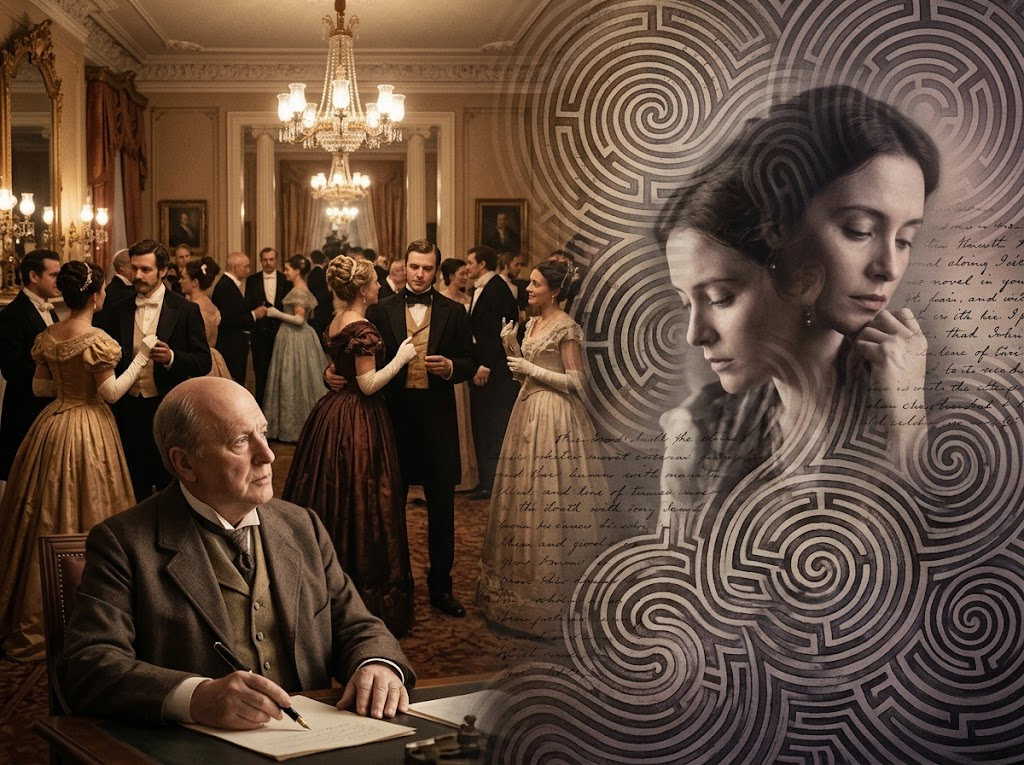
1. Biographical Foundation & The Transatlantic Identity
Born on April 15, 1843, in New York City, Henry James was immersed from infancy in an extraordinary crucible of intellectual privilege.[1:2][4:1] His father, Henry James Sr., was a deeply eccentric Swedenborgian theologian who inherited a massive family fortune, freeing his children from ever having to pursue traditional commercial careers.[3:2] Alongside his older brother William and his brilliant, diarist sister Alice, Henry was subjected to a "haphazard and promiscuous" continental education across Geneva, Paris, London, and Bonn, designed by their father to expose them to fluid, cosmopolitan influences rather than dogmatic national orthodoxies.[2:1][4:2]
During the American Civil War, James sustained an unspecified physical injury—which he famously and obliquely described in his memoirs as an "obscure hurt"—preventing him from military service and reinforcing his posture as a detached, analytical observer of human affairs rather than an active participant.[2:2][3:3]
This peripatetic upbringing birthed James's lifelong artistic obsession with the Transatlantic identity.[4:3] Finding post-Civil War America culturally thin, provincial, and barren for nuanced aesthetic rendering, James relocated permanently to Europe in his thirties, eventually settling in London and later at Lamb House in Rye, Sussex.[2:3] His life became a personal embodiment of his primary literary motif: the clash between the naïve, moral exuberance of the New World and the corrupt, deeply layered wisdom of the Old World.[4:4]
The dynamic of this transatlantic dialectic is articulated across distinct ideological poles:
| Ideological Pole | Core Cultural Virtues | Inherent Vulnerabilities & Liabilities | Representative Exemplars |
|---|---|---|---|
| New World (America) | Innocent moral idealism, democratic egalitarianism, ethical earnestness, fresh vitality | Cultural thinness, provincial insularity, rigid Puritan moralism, naivety | Christopher Newman (The American), Daisy Miller, Isabel Archer |
| Old World (Europe) | Ancient institutional density, refined aesthetic connoisseurship, nuanced social traditions | Cynical interpersonal manipulation, moral decay, decadent greed, corrupting historical weight | Gilbert Osmond, Madame Merle, Prince Amerigo (The Golden Bowl) |
Because provincial American society was steeped in austere moralism, its cultural guardians would routinely take-a-dim-view of European social ambiguity, viewing aesthetic indulgence and cosmopolitan manners as dangerous ethical compromises.
In a final act of devotion to his adopted homeland—and in bitter protest against American neutrality during the opening years of World War I—James renounced his U.S. citizenship to become a British subject in 1915, mere months before his death in February 1916.[2:4][4:5]
2. The Sibling Dynamic: Henry vs. William James
The intellectual dialogue between Henry and William James represents one of the most celebrated sibling relationships in modern cultural history. As children, William was the mercurial, dominant, and scientifically restless older brother, while Henry cast himself as the quiet, passive "devourer of libraries" and peripheral observer.[2:5][4:6] This childhood dynamic crystallized into a profound, lifelong creative rivalry conducted across thousands of letters and parallel intellectual revolutions.[3:4][5]
Despite their divergent professional mediums, the two brothers were fundamentally cut-from-the-same-cloth, shaped by identical Swedenborgian family debates and an obsessive fascination with how the human mind organizes chaotic sensory experience:
| Dimension | William James (Pragmatism & Psychology) | Henry James (Psychological Realism & Narrative Fiction) |
|---|---|---|
| The Shared Subject | The functional mechanics of human consciousness and how the subject processes, selects, and interprets sensory stimuli.[3:5][5:1] | The microscopic rendering of consciousness navigating complex social environments and moral crises.[3:6][5:2] |
| The Textual Inversion | Authored psychological treatises with the narrative flair, warmth, and dramatic vitality of a novelist.[3:7] | Authored novels with the analytical precision, diagnostic detachment, and rigor of a research psychologist.[3:8] |
| Model of Consciousness | Coined and formalized the "stream of consciousness" in The Principles of Psychology (1890).[4:7][5:3] | Engineered the narrative apparatus of the "central consciousness" (or reflector), filtering reality through a limited perspective.[5:4][6] |
| Action & Epistemology | Pragmatism: truth measured by practical "cash-value" and empirical consequences in external reality. | Psychological realism: internal epiphanies and perceptual shifts treated as vital existential actions. |
| Selective Attention ("Interest") | Formulated "interest" as the active cognitive filter that rescues order from sensory chaos.[5:5] | Structured narratives around what the central observer notices, cares for, and misinterprets.[3:9][5:6] |
For both brothers, human identity is not a static soul or fixed substance, but an active, dynamic construct forged by attention. In William's psychological texts and Henry's critical prefaces, the concept of "interest" appears incessantly.[5:7] Both argued that raw reality is an overwhelming, chaotic influx of sensory data; it is solely through the act of noticing, selecting, and caring that a disjointed manifold of experience coalesces into a coherent self and a meaningful world.[3:10][5:8]
3. Narrative Theory & Poetics: The Art of Fiction
Henry James fundamentally revolutionized the trajectory of the English novel by establishing psychological realism as high art.[1:3] In Victorian England, fiction was predominantly treated as light drawing-room diversion, commercial serialization, or didactic moral instruction.[6:1] James repudiated this subservience in his landmark 1884 manifesto The Art of Fiction, demanding that the novel be granted the same aesthetic autonomy, formal dignity, and technical seriousness accorded to painting, music, and philosophy.[5:9][6:2]
The Interiorization of Action
In traditional social realism (practiced by Balzac, Dickens, or William Dean Howells), narrative truth resided in meticulous external descriptions—lineage, dress, commercial balance sheets, and social manners.[5:10][6:3] James recognized that external signifiers could never capture the ambiguity of modern experience. Consequently, he transposed the primary dramatic arena inward.
For James, a character parsing an unspoken glance, wrestling with moral hesitation over tea, or re-evaluating an intimate relationship was infinitely more dramatic than a sudden shipwreck, duel, or inheritance dispute.[5:11][6:4] Plot becomes synonymous with the internal movements of comprehension, requiring the protagonist—and the reader—to continually read-between-the-lines of polite drawing-room conversation to extract the latent emotional reality beneath polished Victorian decorum.
The "House of Fiction" Metaphor
In his monumental prefaces prepared for the 1907–1909 New York Edition of his works, James articulated the definitive spatial metaphor for narrative point of view:[5:12]
"The house of fiction has in short not one window, but a million—a number of possible movements not countable, but every one of which has been or is still possible for need of art and need of life... They are but windows at the best, mere holes in a dead wall, disconnected, perched aloft; they are not hinged doors opening straight upon life. But they have this for their mark, that at each of them stands a figure with a pair of eyes, or at least with a field-glass, which forms, again and again, for observation, a unique instrument, insuring to the person making use of it an impression distinct from every other."[5:13]
This structural metaphor established the cornerstone of modern narrative theory: there is no unmediated, objective "reality" available to the novelist, only situated, subjective perspectives mediated by specific human instruments.[5:14][6:5]
The architectural mechanics of this framework operate through three structural layers:
- The Infinite Apertures: The vast outer facade of the House of Fiction is pierced by countless discrete windows overlooking human existence, each representing a unique literary sensibility and angle of vision.
- The Situated Observer: At every aperture stands a distinct watcher—the "central consciousness" or reflector—equipped with a specific perceptual field, personal biases, and cognitive limitations that dictate what can and cannot be observed.
- The Dramatic Scenic Method: Rather than relying on intrusive authorial summaries, the narrative renders reality through granular perceptual scenes, authentic dialogue, and physical gesture, transforming observation into living drama.
The "Ficelle" and the Scenic Method
Because James strictly adhered to limited point of view, he faced a technical dilemma: how could a novelist reveal necessary exposition, background history, or alternative interpretations without lapsing into intrusive authorial summary?[6:6]
To solve this, James invented the structural device of the "ficelle" (French for "string" or theatrical wire):
- Operational Role: A confidant or sounding-board character who belongs to the social milieu of the story but remains detached from the central dramatic stakes.[6:7]
- Dramatic Function: Through dialogue with the ficelle, the central protagonist naturally articulates their private calculations, anxieties, and illusions in real-time conversation, transforming internal reflection into external dramatic action.[5:15][6:8]
- Canonical Examples: Henrietta Stackpole and Ralph Touchett in The Portrait of a Lady; Maria Gostrey in The Ambassadors.[5:16]
4. Stylistic Evolution Across Three Phases
James's prolific career—comprising 20 novels, 112 novellas and tales, 12 plays, and voluminous criticism—unfolded across three distinct stylistic evolutions:[1:4][4:8]
| Phase / Period | Chronology | Stylistic & Formal Innovations | Central Thematic Focus | Canonical Masterworks |
|---|---|---|---|---|
| Early Phase | 1870s–1881 | Accessible realism, crisp narrative pacing, linear plot progression, balanced social observation | The "International Theme": American innocence confronting European tradition | The American (1877), Daisy Miller (1878), The Europeans (1878), Washington Square (1880) |
| Middle Phase | 1881–1895 | Deepening psychological complexity, wider socio-political canvases, technical experimentation with dramatic form | Moral compromise, institutional politics, radical feminism, the artist's alienation | The Portrait of a Lady (1881), The Bostonians (1886), The Princess Casamassima (1886), The Tragic Muse (1890) |
| Late / Major Phase | 1896–1904+ | Dense, recursive, multi-clause syntax; absolute adherence to the central consciousness; scenic method | Epistemological ambiguity, the predatory gaze, the unlived life, transatlantic betrayal | The Turn of the Screw (1898), The Wings of the Dove (1902), The Ambassadors (1903), The Golden Bowl (1904) |
Key Works Matrix & Structural Architectures
| Masterwork | Year | Genre / Form | Narrative Innovation | Central Thematic Focus |
|---|---|---|---|---|
| Daisy Miller | 1878 | Novella | Limited third-person perspective mediated through Winterbourne's ambivalent social gaze | American innocence vs. rigid Roman expatriate social codes; reputational tragedy |
| The Portrait of a Lady | 1881 | Novel | Extended internal reflective monologue (Chapter 42 fireside vigil); the ficelle technique | Autonomy vs. aesthetic entrapment; Gilbert Osmond's predatory connoisseurship |
| The Turn of the Screw | 1898 | Gothic Novella | Uncorroborated first-person manuscript; absolute epistemological ambiguity | Hallucinatory hysteria vs. objective demonic haunting; the architectural uncanny |
| The Wings of the Dove | 1902 | Novel | Multi-perspectival central consciousness; elliptical, deferred dramatic climaxes | Mortal illness (Milly Theale), mercenary conspiracy (Kate Croy & Merton Densher) |
| The Ambassadors | 1903 | Novel | Rigorous reflector narration (Lambert Strether); scenic method with Maria Gostrey | European sensory awakening vs. New England puritanism; the urge to "live all you can" |
| The Golden Bowl | 1904 | Novel | Symmetrical two-part structure (Prince / Maggie Verver); dense figurative symbolism | Marital betrayal, symbolic fracture (the flawed crystal bowl), moral re-acquisition |
| The Beast in the Jungle | 1903 | Novella | Microscopic diagnosis of existential bad faith; tragic dramatic irony | Narcissistic dread of fate, emotional blindness, passivity as self-annihilation |
| The Jolly Corner | 1908 | Tale | Architectural uncanny; externalized psychoanalytic double (Doppelgänger) | Confrontation with the capitalist alter ego; the terror of the alternative self |
The International Theme & The Portrait of a Lady (1881)
The crowning achievement of his early-to-middle period, The Portrait of a Lady dramatizes the spiritual pilgrimage of Isabel Archer, an independent American heiress endowed with limitless moral optimism and financial liberty.[1:5][4:9] Seeking self-realization in Europe, she encounters the calculating expatriate Madame Merle, who works covertly behind-the-scenes to orchestrate Isabel's introduction and courtship with the dilettante Gilbert Osmond.
Osmond surrounds himself with antique artifacts, constructing an immaculate social persona that serves as a-facade of supreme aesthetic taste, masking an impoverished, tyrannical narcissism. Seduced by the prospect of dedicating her fortune to what she imagines is pure cultural refinement, Isabel ends up fall-into-a-trap carefully engineered by the conspirators, exchanging her boundless American liberty for a claustrophobic marriage of aesthetic subjugation. In the salons of Florence and Rome, both husband and wife maintain an impenetrable poker-face before polite society, hiding their cold, mutual alienation behind an unruffled public veneer.
The pivotal moment of the novel encapsulates James's revolution in psychological realism: Chapter 42 consists entirely of Isabel sitting motionless before a dying hearth late at night, piecing together subtle conversational gestures and glances she previously witnessed. Without a single word spoken or physical action taken, she realizes with chilling clarity that her husband does not love her, but merely possesses her as an ornamental art object in his collection.[4:10][5:17]
The Theatrical Interlude and the "Scenic Method"
In the early 1890s, frustrated by modest book sales and seeking commercial acclaim, James devoted five grueling years to the London theatre.[2:6][4:11] The endeavor culminated in humiliating disaster on January 5, 1895, when his play Guy Domville was viciously jeered and booed off the stage by gallery spectators.[2:7]
Though spiritually devastated, James turned this theatrical catastrophe into a revolutionary technical asset. Returning to prose fiction, he imported strict theatrical principles: dramatic scenes, rigorous dialogue, spatial blocking, and the suppression of authorial commentary.[4:12][6:9] This "scenic method" directly generated the virtuoso narrative economy of his late masterpieces.[6:10]
The Major Phase: The Ambassadors (1903)
In his late trilogy (The Wings of the Dove, The Ambassadors, and The Golden Bowl), James developed an intricate, highly convoluted prose style characterized by suspended syntax, qualify-upon-qualifying clauses, and rich figurative metaphors.[1:6][4:13]
In The Ambassadors, Lambert Strether, an aging editor from Massachusetts, travels to Paris to retrieve Chad Newsome, the wayward son of his wealthy fiancée.[4:14] Expecting to rescue Chad from Parisian debauchery, Strether instead discovers that European culture has civilized, refined, and deepened the young man. As Strether immerses himself in the artistic vitality of Paris, his rigid Puritan preconceptions systematically unravel, culminating in his famous speech in Gloriani's garden: "Live all you can; it's a mistake not to." The narrative action is entirely subordinate to Strether's sensory and intellectual awakening, demonstrating James's mastery of the central consciousness.[4:15][5:18]
5. Gothic Ambiguity, the Supernatural & The Architectural Uncanny
Far from being confined to polite drawing rooms, James was an extraordinary master of psychological horror, producing ghost stories that redefined the supernatural for the modern secular era.[1:7][7]
Traditional Victorian Gothic fiction relied on external demonology, clanking ancestral castles, and clear moral retribution. James transformed this genre into an epistemological Gothic, relocating terror from haunted masonry to the haunted interiority of human consciousness:
- Domestic Geographies: Setting narratives within polite country estates, sunlit drawing rooms, and familiar urban brownstones, showing that the uncanny lurks within the civilized domestic sphere.
- Epistemological Indeterminacy: Refusing external verification, leaving the reader trapped within the protagonist's fallible interpretations.
- Psychoanalytic Dread: Grounding spectral encounters in the horror of the unlived life, repressed trauma, and distorted desires rather than supernatural monsters.
The Turn of the Screw (1898): Epistemological Indeterminacy
James's most celebrated gothic novella serves as the quintessential modern case study in narrative ambiguity.[1:8] Commissioned to care for two orphaned children, Miles and Flora, at the secluded estate of Bly, an unnamed young governess comes to believe the children are being supernaturally corrupted by the demonic apparitions of two deceased servants, Peter Quint and Miss Jessel.[1:9]
Because the entire novella is strictly filtered through the governess's subjective written testimony, James deliberately leaves both the protagonist and the reader suspended in-the-dark:
- The Supernatural Reading: The ghosts are objective, malevolent specters waging spiritual war for the souls of innocent children.[1:10]
- The Psychoanalytic Reading: The ghosts are hallucinations born of the governess's own sexual repression, religious fanaticism, and hysterical psychosis, making her the real threat to the children's lives.[1:11][7:1]
James deliberately balances the evidence so that neither interpretation can be definitively validated, forcing the reader to inhabit the agonizing ambiguity of human perception itself.[1:12][6:11]
The Beast in the Jungle (1903) & The Jolly Corner (1908): The Unlived Life
In The Beast in the Jungle, James provides a devastating diagnosis of existential passivity. John Marcher spends his life consumed by the secret conviction that a unique, catastrophic destiny awaits him like a crouching beast in the jungle. His obsessive anticipation forms a fatal blind-spot in his self-awareness, blinding him to the devoted companionship of May Bartram, who spends decades by his side waiting for him to awaken to human connection. Only after May's death does Marcher realize the chilling truth: the beast was his own hollow detachment, and his unique fate was to be the one man in the world to whom nothing was ever to happen.
In The Jolly Corner, James tackles the architectural uncanny and the theme of the double (Doppelgänger). Spencer Brydon returns to New York after thirty-three years abroad to oversee the renovation of his ancestral family brownstone. Wandering through the vacant, echoing rooms by night, Brydon becomes obsessed with tracking the ghostly double of who he would have become had he remained in commercial Gilded Age America.[7:2] When he finally corners the apparition in the vestibule, he encounters a monstrous figure with a mutilated hand and an arrogant, ravaged face—an acute psychoanalytic dramatization of the repressed alter ego.[7:3]
6. The New York Edition and Modernist Legacy
Between 1907 and 1909, James undertook the monumental task of re-editing his life's work for Charles Scribner's Sons: the 24-volume New York Edition.[1:13][2:8] For this definitive edition, James painstakingly revised the language of his earlier novels to match the dense, nuanced cadences of his late phase, and authored eighteen extensive prefaces.[2:9][5:19]
Collected posthumously by R. P. Blackmur as The Art of the Novel (1934), these prefaces constitute the foundational canon of Anglo-American narrative criticism.[5:20][6:12] In them, James dissected the architecture of fiction with unprecedented analytical precision, establishing the critical vocabulary—point of view, reflector, dramatization, scenification—later codified by Percy Lubbock in The Craft of Fiction (1921).[6:13]
Through his relentless interiorization of narrative action and his rejection of moralistic omniscience, Henry James provided the essential aesthetic bridge linking 19th-century realists like George Eliot and Ivan Turgenev to the high modernist revolutions of Virginia Woolf, James Joyce, and William Faulkner.[1:14][2:10][4:16]
Summary of Core Concepts
| Concept | Theoretical / Aesthetic Definition | Key Works |
|---|---|---|
| Central Consciousness (Reflector) | Filtering narrative events strictly through the limited, subjective perception of a single character rather than relying on an omniscient, god-like narrator. | The Ambassadors, The Portrait of a Lady |
| The House of Fiction | The architectural metaphor positing that literature contains infinite windows overlooking life, each representing a distinct, situated human perspective. | Preface to The Portrait of a Lady (New York Edition) |
| The Ficelle | A non-structural confidant character utilized to elicit the central protagonist's private calculations and motives through organic dialogue. | The Ambassadors (Maria Gostrey), The Portrait of a Lady (Henrietta Stackpole) |
| The International Theme | The moral, social, and cultural friction between uncorrupted American innocence and complex, decadent European tradition. | The American, Daisy Miller, The Portrait of a Lady |
| Epistemological Ambiguity | A narrative architecture wherein textual evidence supports mutually exclusive interpretations, trapping reader and protagonist in radical uncertainty. | The Turn of the Screw, The Sacred Fount |
| The Unlived Life | The existential dread stemming from the realization that one has remained an emotionally passive spectator, bypassing authentic sensory engagement. | The Beast in the Jungle, The Jolly Corner |
| The Scenic Method | The translation of theatrical discipline into prose fiction, rendering narrative through structured dramatic encounters, spatial blocking, and dialogue rather than expository summary. | The Awkward Age, The Wings of the Dove, The Golden Bowl |
---\n
🎴 Interactive Web Practice (Comprehension Check)
Question 1 (Narrative Theory & Point of View): How does Henry James's "central consciousness" (or reflector) technique diverge from Victorian omniscient narration, and how does his "House of Fiction" metaphor justify this shift?
Answer: While Victorian omniscient narration relies on an all-knowing, god-like authorial voice that dispenses objective commentary, moral verdicts, and unmediated background data, James's "central consciousness" technique restricts narrative presentation strictly to what a specific, fallible character can perceive, infer, and feel. In the Preface to The Portrait of a Lady, James conceptualizes the "House of Fiction" as having not one door, but millions of windows overlooking the human spectacle. Because each window represents a distinct watcher with a unique, circumscribed field of view, James argues that objective, unmediated reality is an aesthetic illusion; authentic psychological realism requires rendering experience through the situated, subjective consciousness of individual observers.
Question 2 (The Jamesian Dynamic & Cognitive Philosophy): In what ways does Henry James's narrative method translate his brother William James's psychological theories of the "stream of consciousness" and selective attention ("interest") into literary form?
Answer: While William James coined the "stream of consciousness" in The Principles of Psychology (1890) to describe the continuous, non-linear flow of mental life, Henry provided its functional literary equivalent by designing narratives filtered entirely through subjective interiority. Furthermore, both brothers placed the concept of "interest"—or selective attention—at the center of human selfhood. William argued that consciousness actively shapes reality by selecting which stimuli to care about from an overwhelming sensory manifold; Henry reflected this pragmatist principle by demonstrating that a character's destiny and moral identity are determined not by external physical actions, but by the subtle, microscopic acts of noticing, misinterpreting, and synthesizing their social world.
Question 3 (Gothic Ambiguity & The Architectural Uncanny): How does James redefine the traditional Gothic ghost story in The Turn of the Screw and The Jolly Corner, shifting the locus of dread from external supernaturalism to internal epistemological crisis?
Answer: Rather than employing traditional Gothic devices for simple shocks or moral allegories, James reconfigures the supernatural as a manifestation of the psychological and architectural uncanny. In The Turn of the Screw, he traps the reader within the uncorroborated consciousness of the governess, establishing a permanent epistemological stalemate between objective demonic haunting and subjective, sexually repressed psychosis. In The Jolly Corner, the architectural haunting of the vacant ancestral brownstone serves as an externalized encounter with Spencer Brydon's repressed alter ego—the monstrous American capitalist self he might have become. In both masterworks, the terror does not arise from external monsters, but from the claustrophobia and radical uncertainty of the subjective mind confronting its own unacknowledged depths.
Resonant Notes
The following notes in the vault share direct thematic, philosophical, and literary connections with Henry James:
🟣 Core Lexical Syllabus & Applied Metaphoric Expressions
- cut-from-the-same-cloth (Weaving, Textiles & The Loom) — Examines the remarkable fraternal dynamic between Henry and his older brother William James; though one founded American pragmatist psychology and the other pioneered modern psychological realism, both thinkers were cut from the same cloth, emerging from the same Swedenborgian intellectual crucible and obsessively investigating how selective attention (interest) constructs human reality.
- take-a-dim-view (Light & Vision) — Personifies the provincial, puritanical gaze of Woollett, Massachusetts in The Ambassadors, where the formidable matriarch Mrs. Newsome and her envoys take a dim view of European aesthetic culture, reflexively interpreting Lambert Strether's Parisian awakening as degenerate moral backsliding.
- read-between-the-lines (Paper & Print) — Epitomizes the central technical demand of Jamesian psychological realism, where the true narrative action bypasses external melodrama and requires both the central consciousness and the reader to constantly read between the lines of polite Victorian tea-table banter, decoding pregnant silences, deflected glances, and elliptical moral subtext.
- behind-the-scenes (Music & Theater) — Characterizes the predatory social architecture of Old World drawing rooms, where figures like Madame Merle (The Portrait of a Lady) and Kate Croy (The Wings of the Dove) operate masterfully behind the scenes, orchestrating interpersonal alliances and financial entrapments while maintaining a spotless public decorum.
- a-facade (Buildings & Structures) — Embodies the polished, deceptive aestheticism of Gilbert Osmond and Madame Merle in The Portrait of a Lady, who construct a facade of aristocratic refinement, connoisseurship, and disinterested taste to entrap Isabel Archer and conceal their cynical, predatory conspiracy for her fortune.
- fall-into-a-trap (Hunting, Tracking & Trapping) — Captures the tragic trajectory of Isabel Archer in The Portrait of a Lady, whose romantic idealism and hunger for autonomous self-actualization lead her directly into falling into a trap engineered by Gilbert Osmond and Madame Merle, exchanging boundless American freedom for a claustrophobic marriage of aesthetic subjugation.
- poker-face (Games & Gambling) — Captures the defensive armor of James's transatlantic aristocrats and calculating expatriates, such as Gilbert Osmond in The Portrait of a Lady and Charlotte Stant in The Golden Bowl, who maintain an impenetrable social poker face to conceal illicit passions, financial desperation, and predatory domestic tyranny behind smooth, unruffled civility.
- unravel (Weaving, Textiles & The Loom) — Illustrates Lambert Strether's transformative psychological pilgrimage in The Ambassadors, where his rigid, puritanical New England moral certainties systematically unravel in Paris as he encounters the vibrant aesthetic complexity of Chad Newsome's world, culminating in his impassioned plea to "live all you can."
- in-the-dark (Light & Vision) — Articulates the radical epistemological indeterminacy of The Turn of the Screw, wherein James deliberately keeps both the reader and the unnamed governess suspended in the dark, constructing a psychological trap where supernatural demonic haunting and sexually repressed hysteria remain permanently undecidable.
- blind-spot (Light & Vision) — Diagnoses the tragic, narcissistic existential fixation in The Beast in the Jungle, where John Marcher's lifelong dread of an impending, catastrophic destiny acts as a fatal blind spot, completely blinding him to May Bartram's selfless love and condemning him to the horror of an entirely unlived life.
🔴 Consciousness, Pragmatism & The Architecture of Mind
- William James — Fraternal and intellectual counterpart who formulated the "stream of consciousness" and the pragmatic doctrine of selective attention (interest). While William grounded consciousness in physiology and pragmatist philosophy, Henry operationalized it into the "central consciousness" of modern narrative craft.
- Emanuel Swedenborg — The mystical Swedish philosopher whose theology profoundly shaped the James household through Henry James Sr. Swedenborg's doctrine of correspondences—where external physical realities mirror internal spiritual states—directly informed Henry's symbolic use of houses, portraits, and material objects as reflections of psychic interiority.
- Henri Bergson — Bergson's philosophical distinction between mechanical clock time and lived, qualitative duration (durée) provides the ontological parallel to James's narrative pacing, where a few seconds of internal epiphany (such as Isabel Archer's fireside vigil) receive far greater narrative weight than years of external events.
- Carl Gustav Jung — Jung's archetypal theories of the shadow and individuation mirror James's fiction of the double (Doppelgänger), particularly in The Jolly Corner, where the protagonist must confront the grotesque, repressed version of his unlived self.
🟡 Modernism, Narrative Poetics & Epistemological Ambiguity
- Virginia Woolf — Inherited James's "central consciousness" technique and his "House of Fiction" spatial poetics, developing them into the fluid, multi-perspectival interior monologues of To the Lighthouse and Mrs Dalloway. Both writers shifted the drama of literature from external plot mechanics to granular internal perceptions.
- James Joyce (1882-1941) — High modernist pioneer who pushed James's interiorization of action to its ultimate linguistic extreme. Where James meticulously chronicled the formal, civilized syntax of reflective thought, Joyce dismantled syntactic barriers to capture the raw, unfiltered flow of the subconscious mind.
- Franz Kafka (1883-1924) — Both writers construct rigorous narratives founded on epistemological entrapment, restricting narrative perspective so tightly to the protagonist's subjective predicament that the reader cannot appeal to an external, objective reality to resolve existential ambiguity.
- John Updike's Main Literary Themes — Inheritor of Jamesian psychological realism who transposes James's microscopic social analysis and moral nuance from European salons and Gilded-Age aristocrats to the suburban landscapes of 20th-century America.
🟢 Aesthetic Autonomy, Existential Choice & The Uncanny
- The Dehumanization of Art — Ortega y Gasset's formulation of modern art's refusal to serve as an easy emotional mirror reflects James's late style, which deliberately rejects sentimental Victorian mimesis in favor of complex, formalist architecture that demands active intellectual co-creation from the reader.
- Freud's The Uncanny (Das Unheimliche) — James's ghost stories, particularly The Turn of the Screw and The Jolly Corner, operate as classic literary embodiments of Freud's Unheimliche: the return of the repressed, the horrifying double, and the defamiliarization of the domestic home.
- Edgar Allan Poe (1809-1849) — Predecessor in transatlantic psychological horror and unreliable narration. James refined Poe's macabre obsession with haunted interiors and psychological obsession into the civilized, drawing-room terrors of modern psychological realism.
- Jean-Paul Sartre — James's interiorization of dramatic action—where the defining moments of existence occur during silent, solitary deliberations over personal bad faith and moral responsibility—serves as the fictional precursor to Sartrean existentialism.
- Northrop Frye's - Anatomy of Criticism — James's developmental trajectory from the accessible social manners of Daisy Miller to the dense, ironic ambiguities of The Golden Bowl maps directly onto Frye's structural progression from the Low Mimetic to the Ironic mode of literary history.
References
De Vere Society / Henry James Portfolio / deveresociety.co.uk ↩︎ ↩︎ ↩︎ ↩︎ ↩︎ ↩︎ ↩︎ ↩︎ ↩︎ ↩︎ ↩︎ ↩︎ ↩︎ ↩︎ ↩︎
Leon Edel / Henry James: A Life / Harper & Row ↩︎ ↩︎ ↩︎ ↩︎ ↩︎ ↩︎ ↩︎ ↩︎ ↩︎ ↩︎ ↩︎
Psychology Today / Oh Those Fabulous James Boys! / Psychology Today ↩︎ ↩︎ ↩︎ ↩︎ ↩︎ ↩︎ ↩︎ ↩︎ ↩︎ ↩︎ ↩︎
Encyclopaedia Britannica / Henry James: American Novelist, Short Story Writer, Critic / Britannica ↩︎ ↩︎ ↩︎ ↩︎ ↩︎ ↩︎ ↩︎ ↩︎ ↩︎ ↩︎ ↩︎ ↩︎ ↩︎ ↩︎ ↩︎ ↩︎ ↩︎
Henry James / The Art of the Novel: Critical Prefaces (ed. R. P. Blackmur) / Charles Scribner's Sons / University of Chicago Press ↩︎ ↩︎ ↩︎ ↩︎ ↩︎ ↩︎ ↩︎ ↩︎ ↩︎ ↩︎ ↩︎ ↩︎ ↩︎ ↩︎ ↩︎ ↩︎ ↩︎ ↩︎ ↩︎ ↩︎ ↩︎
Percy Lubbock / The Craft of Fiction / Jonathan Cape / Project Gutenberg ↩︎ ↩︎ ↩︎ ↩︎ ↩︎ ↩︎ ↩︎ ↩︎ ↩︎ ↩︎ ↩︎ ↩︎ ↩︎ ↩︎
Sigmund Freud / The Uncanny (1919) / Standard Edition of the Complete Psychological Works of Sigmund Freud ↩︎ ↩︎ ↩︎ ↩︎