Emanuel Swedenborg
🗂️ Interactive Notebook: Open Emanuel Swedenborg Study Companion (Video Summary, Flashcards, Mind Map) ↗
Emanuel Swedenborg (1688—1772) was a Swedish scientist, mechanical inventor, natural philosopher, Christian theologian, and visionary seer whose work fundamentally shaped Western esotericism, American Transcendentalism, European Romanticism, and early depth psychology. Following five decades as one of Scandinavia's foremost Enlightenment minds—pioneering studies in metallurgy, mechanics, paleontology, and the neuroanatomy of the cerebral cortex—Swedenborg underwent an acute spiritual and psychological transformation in the mid-1740s. Claiming uninhibited, conscious entry into the spiritual world while remaining awake in the physical realm, Swedenborg applied the empirical, taxonomic methodology of an eighteenth-century naturalist to the celestial and infernal landscapes. His monumental theological corpus posited the Doctrine of Correspondences, articulated an ontological cosmos governed by Discrete Degrees, reconceived heaven and hell as self-determined psychological projections of one's Ruling Love (amor regens), and described the spiritual universe as a unified cosmic organism: the Divine Human (Maximus Homo).[1][2]
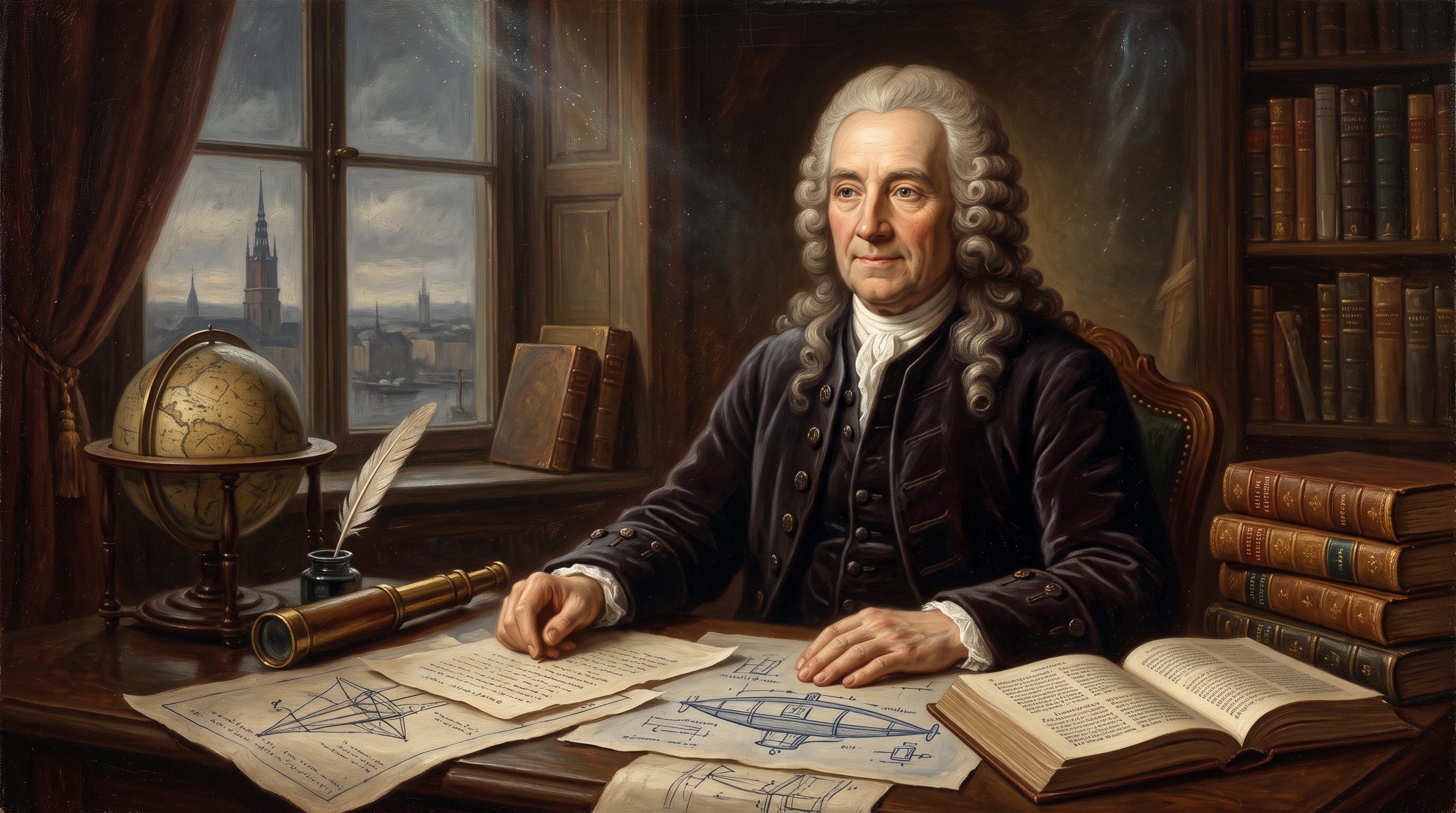
1. Biographical Trajectory: From Technical Polymath to Systemic Seer
Emanuel Swedenborg's intellectual career represents one of the most remarkable ruptures in the history of European ideas. Far from being a lifelong recluse or traditional religious fanatic, Swedenborg operated for the majority of his adult life at the epicenter of Swedish industrial, scientific, and political power.[1:1]
| Life Phase | Chronological Span | Primary Institutional & Intellectual Context | Major Publications & Milestones |
|---|---|---|---|
| Enlightenment Polymath & Inventor | 1688–1733 | Assessor on Royal Board of Mines; protégé of Christopher Polhem and King Charles XII. Focus on mining, metallurgy, hydraulics, and astronomy. | Founded Daedalus Hyperboreus (1716–1718); published treatises on mineralogy, geology, and early aeronautical and submarine designs. |
| Philosophical & Neuroanatomical Inquiry | 1734–1742 | Quest for the physical interface between the soul and matter; European anatomical research tours across England, France, and Italy. | Principia Rerum Naturalium (1734); The Economy of the Animal Kingdom (1740–1741); The Animal Kingdom (1744–1745). |
| Spiritual Crisis & Awakening | 1743–1745 | Psychological breakdown, hypnagogic crises, intense dream recordings; mystical vision in London (April 1745). | Private Journal of Dreams (Drömboken); The Word Explained (Adversaria); resignation from the Board of Mines. |
| Visionary Exegesis & Theological Revelation | 1745–1772 | Resident in Stockholm, London, and Amsterdam; full-time spiritual cartography and biblical internal hermeneutics. | Arcana Coelestia (1749–1756); Heaven and Hell (1758); Divine Love and Wisdom (1763); The True Christian Religion (1771). |
The Scientific Search for the Soul's Biological Seat
During the 1730s and early 1740s, Swedenborg grew dissatisfied with Cartesian mechanistic philosophy, which posited an unbridgeable metaphysical divide between extended matter (res extensa) and thinking substance (res cogitans). Convinced that the soul was not an abstract ghost but an active formative force operating within physical anatomy, Swedenborg immersed himself in European medical academies.
In The Economy of the Animal Kingdom (Oeconomia Regni Animalis, 1740–1741) and The Animal Kingdom (Regnum Animale, 1744–1745), Swedenborg made staggering neuroanatomical discoveries that anticipated nineteenth- and twentieth-century medicine:
- Cerebral Cortex Localization: He was among the first natural philosophers to identify the cerebral cortex—rather than the fluid of the ventricles or the pineal gland—as the definitive seat of sensory perception, voluntary movement, and cognitive thought.[2:1]
- The Motion of the Brain: He demonstrated that the brain undergoes synchronous pulsation with the lungs rather than the heart, tracing the vital function of cerebrospinal fluid through the central nervous system.[2:2]
- The Limits of Mechanism: Despite his anatomical precision, Swedenborg concluded that empirical dissection could never lay bare the immaterial soul itself; physical matter could only demonstrate the biological vessels through which higher transcendent forces descend.
The London Epiphany and Waking Clairvoyance
In 1743–1744, while working in The Hague and London, Swedenborg suffered severe bouts of insomnia, profound religious guilt, and hypnagogic hallucinations recorded in his secret Journal of Dreams. The crisis culminated in April 1745 at a London inn, where Swedenborg reported a waking vision of Christ, who informed him that his spiritual senses were being opened so that he might disclose the true, interior meaning of the Holy Scriptures and describe the conditions of the spiritual realm to a secularizing Enlightenment humanity.[1:2]
Rather than experiencing a temporary ecstatic raptus that ended with a return to ordinary consciousness, Swedenborg claimed that from 1745 until his death in 1772, his spiritual sight remained permanently operative. He lived in a continuous state of "double consciousness": conversing with friends and conducting business in London or Stockholm while simultaneously observing and communicating with departed spirits, angels, and demons in the spiritual world.[1:3][2:3]
2. Metaphysical Architecture: Degrees, Influx, and Correspondences
Swedenborg's metaphysics is neither an absolute monism nor a Cartesian dualism; it is a tripartite, layered ontology coordinated through continuous divine influx (influxus divinus).
| Ontological Level | Reality Domain | Substance & Mode | Corresponding Human Faculty | Scriptural & Hermeneutic Sense |
|---|---|---|---|---|
| Celestial Realm | The Inmost / End (Finis) | Divine Love (Amor Divinus); warmth; pure affection. | The Will (Voluntas); intuitive love; emotional core. | Celestial Sense: Divine union, innermost spiritual love. |
| Spiritual Realm | The Mediate / Cause (Causa) | Divine Wisdom (Sapientia Divina); light; truth and form. | The Understanding (Intellectus); rationality; truth. | Spiritual Sense: Spiritual development and church regeneration. |
| Natural Realm | The Outermost / Effect (Effectus) | Material space, time, physical mass, biological organism. | The Somatic Body; outer senses; physical actions. | Literal / Historical Sense: Historical narratives, material commands. |
The Doctrine of Discrete Degrees vs. Continuous Degrees
To prevent pantheism (the conflation of God with nature) and materialism (the reduction of mind to physical atoms), Swedenborg distinguished sharply between two distinct modes of reality:
- Continuous Degrees (Degrees of Breadth / Latitude): Quantitative variations within the same plane of being, moving along a continuum from coarse to fine, dense to rare, or dim to bright (such as variations in temperature, air pressure, or physical density).
- Discrete Degrees (Degrees of Altitude / Height): Qualitative, ontological thresholds that separate levels of being (End, Cause, and Effect). Discrete degrees do not blend into one another; natural matter can never become spiritual substance through refinement, nor can spiritual thought turn into physical atoms. Instead, higher degrees act into lower degrees like the human will acting into physical muscles.[1:4]
The Doctrine of Correspondences (Correspondentia)
Because discrete degrees cannot merge, they are dynamically bound together through Correspondences. A correspondence is the active, lawful relationship between a higher spiritual cause and its lower material effect:
- The Natural World as Mirror: The physical universe possesses no autonomous vitality; every physical object, geological structure, plant, and animal is an outward, tangible emblem of a corresponding spiritual affection or intellectual truth. A lion corresponds to divine power or the courage of truth; a lamb to innocence and gentle affection; a serpent to sensory delusion and base worldly appetites.[1:5]
- Hermeneutic Decoding: Swedenborg applied this correspondence theory to Christian Scripture. In works like Arcana Coelestia (comprising 8 massive volumes), he engaged in a phrase-by-phrase exegesis of Genesis and Exodus, arguing that the literal, historical narrative (kings, battles, genealogical lineages) serves merely as a shell housing an unbroken internal spiritual sense detailing the regeneration of the human soul.[1:6][2:4]
Divine Influx and the Divine Sun
- The Divine Sun as Spiritual Origin: Swedenborg asserted that the spiritual world possesses a spiritual Sun, which is the immediate emanation of the Divine Human. While the physical sun emits physical light and heat that vivify material biology, the spiritual Sun radiates Divine Wisdom as Light (which illuminates human intellects) and Divine Love as Heat (which warms human wills).
- Humanity as Receptive Vessel: Human beings possess no autonomous life of their own. The human soul is an organum recipientis—a finely tuned biological and psychic receptacle perpetually sustained by incoming divine influx. Evil does not originate as an independent ontological force created by God; it arises when the receptive vessel twists, perverts, or suffocates the incoming divine love into selfish egoism.[1:7]
3. The Architecture of the Afterlife: Ruling Love and the Maximus Homo
Swedenborg revolutionized European eschatology by completely rejecting medieval, Dantean depictions of heaven as an arbitrary court of reward and hell as a subterranean chamber of judicial torture operated by horned demons.
| Dimension | Swedenborgian Spiritual Doctrine | Traditional Orthodoxy / Medieval Scholasticism |
|---|---|---|
| Nature of Passing | Seamless psychological awakening; continuation of individuality, memory, and cognitive identity. | Radical ontological rupture; bodily sleep awaiting bodily resurrection or purgatorial cleansing. |
| The Intermediate Realm | The World of Spirits (Mundus Spirituum): A neutral space where external pretenses are gradually discarded. | Purgatory (temporary punitive purgation of venial sins) or immediate Limbo. |
| Determination of Fate | The Ruling Love (Amor Regens): The internal, dominant affection chosen freely in earthly life. | Judicial decree rendered by an extrinsic divine judge based on a ledger of merits. |
| Etiology of Hell | Psychological and spiritual projection of unrestrained egoism; inhabitants actively choose hell. | Divine punishment; physical sulfur and fire inflicted by God or demonic jailers. |
| Cosmic Structure | The Grand Man (Maximus Homo): The entire spiritual cosmos organized as a unified human organism. | Hierarchical Ptolemaic spheres or crystalline angelic choirs centered on a geometric throne. |
The Intermediate State (Mundus Spirituum)
Upon the physical death of the body, Swedenborg reported that the soul is resuscitated within two or three days by angels, awakening in the intermediate World of Spirits situated between heaven and hell. In this realm:
- The Phase of the Exterior: The individual retains their familiar social persona, polite masks, and external manners, reuniting with friends and relatives.
- The Phase of the Interior: Gradually, external inhibitions fall away. The soul's true interior affections, hidden desires, and unspoken motives are brought into absolute alignment with their outward appearance. Hypocrites can no longer simulate righteousness; their inner corruption manifests directly in their spiritual appearance.
- The Final Alignment: Once the exterior matches the interior, individuals gravitate spontaneously to the community that shares their dominant desire.
The Law of Ruling Love (Amor Regens)
Swedenborg insists that God casts no one into hell; hell is entirely self-chosen. Every human life is animated by a core love:
- Heavenly Love (Charity & Humility): Those whose ruling love is selfless, centered on love for God and mutual service toward the neighbor, find the radiant light and warmth of heaven intoxicatingly delightful. They aggregate into angelic societies based on shared affinities.
- Infernal Love (Self-Love & Domination): Those whose ruling love is defined by selfishness, greed, cruelty, and the lust to dominate others find the light of heaven agonizing and blinding. To them, divine truth feels like a burning poison. Consequently, they flee voluntarily into dark caverns, ruined cities, and foul-smelling pits that constitute hell. Hell is simply the externalized reality of the ego turned in upon itself.[1:8]
The Cosmic Human: Maximus Homo
Perhaps Swedenborg's most daring metaphysical concept is the Universal Human (Maximus Homo or the Grand Man). Swedenborg claimed that the entire spiritual cosmos is structured in the human form:
- Divine Anthropomorphism: God is not an impersonal geometric void or diffuse gaseous mist, but the quintessential Divine Human (Divinum Humanum).
- Organic Integration: Because creation reflects the Creator, angelic communities are organized according to the anatomical and physiological functions of the human body. Certain angelic societies correspond to the heart (celestial love and the circulation of life), others to the lungs (spiritual wisdom and intellectual respiration), others to the eyes (perceptive insight), and others to the hands or feet (practical ultimate action). Every individual angel functions as a microscopic human, their community functions as a larger human, and the entirety of heaven functions as a single cosmic human living in divine harmony.[1:9][2:5]
4. Philosophical Matrix: Swedenborg vs. Major Enlightenment Frameworks
To appreciate Swedenborg's unique position in the history of philosophy, his thought must be situated against the primary metaphysical models of early modern Europe:
| Metaphysical Vector | Emanuel Swedenborg | René Descartes | Gottfried Wilhelm Leibniz | Baruch Spinoza |
|---|---|---|---|---|
| Ontological Structure | Tripartite Discrete Hierarchy: Celestial, Spiritual, and Natural degrees bound by influx and correspondences. | Substance Dualism: Absolute separation between extended matter (res extensa) and unextended mind (res cogitans). | Pluralistic Idealism: Infinite non-interacting immaterial "monads" reflecting the cosmos. | Substance Monism (Pantheism): One infinite substance (Deus sive Natura) with infinite attributes (thought and extension). |
| Mind-Body Problem | Divine Influx & Correspondence: The spiritual degree acts dynamically into the physical vessel like will into muscles. | Pineal Interaction: Problematic mechanical interaction localized at the pineal gland. | Pre-Established Harmony: Clocks wound up by God running in synchronized parallel without interaction. | Psychophysical Parallelism: Mind and matter are two simultaneous aspects of the same single divine substance. |
| Conception of God | The Divine Human: Personal, embodied in Jesus Christ; Divine Love and Divine Wisdom as cosmic sun. | Transcendent Architect: Infinitely perfect, non-corporeal First Cause ensuring the truth of mathematics. | Supreme Monad: Perfect Calculator who selects and actualizes the best of all possible worlds. | Immanent Substance: Impersonal Nature itself, devoid of anthropomorphic emotion, will, or external purpose. |
| Epistemology | Empirical Seership: Systematic spiritual observation combined with correspondential biblical decoding. | Rationalist Deduction: Methodological doubt leading to clear and distinct foundational ideas. | Rational Calculus: Principle of Sufficient Reason and innate conceptual truths. | Geometrical Reason / Intuition: Intellectual love of God (amor intellectualis Dei) through deductive proofs. |
| Human Freedom | Dynamic Equilibrium: Freedom maintained by an exact balance between heavenly and infernal influx. | Volitional Autonomy: Infinite human will capable of exceeding finite intellect. | Spontaneous Compatibilism: Freedom consists in rational self-determination according to monad's inner nature. | Strict Determinism: Human freedom is an illusion caused by ignorance of the causes determining our actions. |
5. Chronological Synthesis of Major Works
Swedenborg produced an enormous corpus spanning dozens of multi-volume treatises. His major works can be classified into his scientific-anatomical foundations and his revelatory theological output:
| Work | Publication Year | Original Language | Core Philosophical & Thematic Thrust | Lasting Intellectual Contribution |
|---|---|---|---|---|
| Principia Rerum Naturalium | 1734 | Latin (Dresden & Leipzig) | Formulates a mechanical-vortical theory of matter; posits that atoms are dynamic energy vortices. | Anticipated early cosmological nebular hypotheses and magnetic field theories. |
| The Economy of the Animal Kingdom | 1740–1741 | Latin (Amsterdam) | Anatomical study of blood, heart, and the cerebral cortex; search for the soul's physical locus. | Pioneered cerebral localization and cortical function in modern neuroanatomy. |
| Journal of Dreams (Drömboken) | 1743–1744 | Swedish (Private Diary) | Intimate psycho-spiritual records of dreams, erotic anxieties, cognitive breakdown, and visions. | Landmark text in the psychological history of visionary crisis and the unconscious. |
| Arcana Coelestia (Heavenly Secrets) | 1749–1756 | Latin (London, 8 vols.) | Verse-by-verse correspondential exegesis of Genesis and Exodus; internal spiritual sense revealed. | The foundational masterwork of Swedenborgian scriptural hermeneutics and correspondences. |
| Heaven and Hell (De Caelo et de Inferno) | 1758 | Latin (London) | Comprehensive empirical cartography of the spiritual world, angelic societies, and infernal states. | The most widely read and translated work of Western visionary eschatology. |
| Divine Love and Wisdom | 1763 | Latin (Amsterdam) | Systematic metaphysics of Discrete Degrees, the spiritual Sun, and continuous divine influx. | Primary philosophical treatise establishing his ontology of love as prime substance. |
| Divine Providence | 1764 | Latin (Amsterdam) | The reconciliation of divine omniscience and benevolence with human free will and the existence of evil. | Outlines spiritual equilibrium and the active laws governing moral agency. |
| Conjugial Love (Amor Conjugialis) | 1768 | Latin (Amsterdam) | The metaphysics of gender, marriage, and spiritual union enduring eternally into the afterlife. | Profoundly influenced Romantic theories of soulmates, Balzac, and the psychology of sexuality. |
| The True Christian Religion | 1771 | Latin (Amsterdam) | Final systematic theology; comprehensive restatement of Christology, the Divine Human, and the New Church. | The definitive doctrinal textbook for the Swedenborgian "New Church" movement. |
6. Intellectual Legacy, Cross-Disciplinary Influence, and Philosophical Critiques
Emanuel Swedenborg’s idiosyncratic synthesis of Enlightenment empirical rigor and visionary mysticism exerted an immense, enduring impact across European philosophy, nineteenth-century literature, and twentieth-century psychology.
| Intellectual Tradition | Key Figures | Seminal Texts / Concepts | Nature of Swedenborgian Influence |
|---|---|---|---|
| German Idealism | Immanuel Kant | Dreams of a Spirit-Seer (1766); critique of dogmatic metaphysics | Epistemological catalyst; forced the critical demarcation between knowable sensory phenomena and unknowable noumena. |
| English Romanticism | William Blake | The Marriage of Heaven and Hell (1790–1793); The Four Zoas | Parodied Swedenborg's moralistic categories while adapting his cosmic human (Albion / Maximus Homo) and dialectic of contraries. |
| American Transcendentalism | Ralph Waldo Emerson, Henry David Thoreau, Walt Whitman | Representative Men (1850); Walden; Leaves of Grass | Adopted the Doctrine of Correspondences; re-envisioned the physical universe as a living symbolic scripture and divine mirror. |
| Modern Psychology | William James, Carl Gustav Jung | The Varieties of Religious Experience (1902); Active Imagination & Archetypes | Precursor to radical empiricism and depth psychology; visionary states reinterpreted as waking active imagination and autonomous archetypal complexes. |
1. Immanuel Kant and the Demarcation of Reason
In 1766, Immanuel Kant published his famous, biting satire Dreams of a Spirit-Seer Illustrated by Dreams of Metaphysics (Träume eines Geistersehers). Kant had purchased Swedenborg's expensive eight-volume Arcana Coelestia and investigated Swedenborg's famous clairvoyant feats (such as his real-time vision of the 1759 Stockholm fire while residing in Gothenburg, three hundred miles away).[1:10]
While publicly mocking Swedenborg’s detailed descriptions of spirits as the delirious hallucinations of a madman, Kant privately recognized that traditional rationalist metaphysics (represented by Christian Wolff and Leibniz) lacked the epistemological criteria to disprove Swedenborg's claims. If metaphysical philosophers could claim knowledge of immaterial souls without empirical sensory data, they were no more rigorous than Swedenborg. The encounter with Swedenborg acted as a crucial catalyst driving Kant toward his Critique of Pure Reason (1781), compelling him to draw an unbridgeable boundary between phenomena (the knowable world of sensory experience structured by space and time) and noumena (the unknowable thing-in-itself).
2. William Blake: Contraries and the Dialectic of Energy
English poet and printmaker William Blake was raised in a household familiar with Swedenborgian tracts, and both he and his wife Catherine signed the register of the First General Conference of the New Church in London in 1789. However, Blake quickly rebelled against Swedenborg's moralistic tendencies, his rigid puritanical classification of angels as good and demons as evil, and his systematic conventionality.
In The Marriage of Heaven and Hell (1790–1793), Blake explicitly parodied Swedenborg's "Memorable Relations" with his own "Memorable Fancies." Blake inverted Swedenborg’s categories, arguing that Swedenborg's angels were passive, cold, and dogmatic moralists, while the devils represented active, divine poetic energy: "Without Contraries is no progression. Attraction and Repulsion, Reason and Energy, Love and Hate, are necessary to Human existence." Yet even in his rebellion, Blake remained profoundly Swedenborgian: his entire mythological cosmos (The Four Zoas, Jerusalem) is constructed around the giant cosmic human Albion, a direct adaptation of Swedenborg's Maximus Homo.
3. American Transcendentalism and the Sacramental Landscape
In nineteenth-century America, Swedenborg found his most influential champion in Ralph Waldo Emerson. Emerson devoted an entire lecture to Swedenborg in Representative Men (1850), christening him "The Mystic." Emerson celebrated Swedenborg’s correspondence theory as the philosophical antidote to dry Scottish Common Sense empiricism and John Locke's tabula rasa:
"The imaginative faculty of the mind is that which handles the world, and uses it as a symbol for thought... Swedenborg saw that the world is a book of symbols, and that everything in it stands for a thought." — Ralph Waldo Emerson, Representative Men (1850)
Through Emerson, Swedenborgian correspondence theory became the structural grammar of American Transcendentalism:
- Henry David Thoreau: Thoreau radicalized Swedenborg’s correspondences at Walden Pond. Where Swedenborg insisted that natural facts correspond to rigid, fixed biblical dogmas, Thoreau held that natural facts correspond directly to the unmediated vitality of wild nature and human consciousness.
- Walt Whitman: Whitman adopted the cosmic human framework in Leaves of Grass, declaring that his own somatic body contained the entire universe and singing an egalitarian correspondence between physical democracy and cosmic spirituality.
4. French Symbolism: Baudelaire, Balzac, and Strindberg
In nineteenth-century France, Swedenborg’s concept of correspondence provided the cornerstone for the Symbolist movement in literature and art:
- Charles Baudelaire: Baudelaire’s celebrated sonnet Correspondances in Les Fleurs du mal (1857)—declaring that "Nature is a temple where living pillars / Sometimes allow confused words to emerge... In a deep, dark unity / Vast like the night and like the light"—is a direct poetic transposition of Swedenborg’s doctrine into aesthetic synesthesia, where perfumes, sounds, and colors correspond to inward psychic states.[2:6]
- Honoré de Balzac: Balzac composed an explicitly Swedenborgian philosophical novel, Séraphîta (1834), depicting an androgynous being on the verge of angelic transfiguration in a Norwegian fjord, praising Swedenborg as the "Buddha of the North."
- August Strindberg: During his psychological crisis in Paris (the Inferno period of the 1890s), the Swedish playwright found his mental sanity restored by reading Swedenborg, interpreting his tormenting delusions not as schizophrenia, but as Swedenborgian "disciplinary spirits" purifying his ego.
5. The James Family: From Swedenborgian Theology to Radical Empiricism
The intellectual lineage of the American James family is inextricably intertwined with Swedenborg:
- Henry James Sr.: The patriarch of the family suffered a catastrophic panic attack and existential dread (which he termed a "vastation") in Windsor, England, in 1844. He found mental liberation and spiritual salvation through Swedenborg's writings, spending the remainder of his life publishing eccentric philosophical works arguing that individual selfhood (proprium) is an illusion that must be dissolved into the Divine Human.
- William James: William grew up immersed in his father’s Swedenborgian debates. This background directly influenced William’s The Varieties of Religious Experience (1902) and his philosophy of Radical Empiricism. William applied his famous pragmatic maxim—evaluating spiritual experiences not by their dogmatic orthodoxy, but by their practical, psychological fruits: "By their fruits ye shall know them, not by their roots."
- Henry James (1843—1916): In novels like The Portrait of a Lady and The Ambassadors, Henry James translated Swedenborgian correspondences into the fine psychological textures of the novel of consciousness. In the Jamesian universe, houses, antique furnishings, gardens, and art objects function correspondentially as psychological reflections of their owners' moral and psychic interiority.
6. Carl Gustav Jung and Depth Psychology
In the twentieth century, Carl Gustav Jung recognized Swedenborg as an essential forerunner of modern depth psychology:
- Active Imagination: Jung noted that Swedenborg’s technique of conversing with spirits while fully conscious was the first documented historical prototype of active imagination—the therapeutic practice of entering a waking trance to engage directly with personified figures of the unconscious.
- Archetypal Complexes: In his seminars and autobiographical writings (Memories, Dreams, Reflections), Jung argued that Swedenborg’s "spirits" were not external discarnate ghosts, but autonomous psychic complexes and archetypal projections of the collective unconscious. Swedenborg was an explorer of the inner psyche who, lacking twentieth-century psychological vocabulary, articulated his voyages through the available theological terminology of his era.[1:11]
🎴 Interactive Web Practice (Comprehension Check)
Question 1 (Scientific Epistemology & The Seer Transition): How did Swedenborg's earlier career as a mechanical inventor, mining engineer, and neuroanatomist directly inform the methodology, rhetorical style, and epistemological claims of his visionary theological works?
Answer: Unlike traditional Christian mystics whose testimonies are characterized by apophatic silence (declaring the divine unutterable), ecstatic emotional frenzy, or the complete dissolution of the rational ego into the void, Emanuel Swedenborg approached the spiritual world with the empirical, systematic mindset of an eighteenth-century Enlightenment naturalist.
Throughout his scientific career, Swedenborg specialized in observational taxonomy, subterranean geology (as assessor on the Royal Board of Mines), physical metallurgy, and cortical neuroanatomy (tracing the physical seat of the soul in the cerebral cortex). When his spiritual vision opened in the 1740s, he imported this exact methodology into his theological corpus:
- Empirical Cartography: Rather than presenting his visionary encounters as poetic allegories or divine dictation, Swedenborg claimed to walk through the intermediate world, heaven, and hell as an objective traveler-naturalist, recording the architecture, botanical structures, angelic societies, social laws, and clothing of spirits with clinical, detached precision.
- Waking Consciousness: Swedenborg insisted that his experiences occurred not during sleep, trance, or sensory deprivation, but while fully awake, writing at his desk with unimpaired critical reason.
- Natural Metaphysics: His spiritual cosmology operated under strict, predictable structural laws (Discrete Degrees, Divine Influx, and Correspondences) that functioned with the same mathematical coherence that he had previously sought in Newtonian mechanics and cortical circulation.
Question 2 (Discrete Degrees vs. Continuous Degrees in Afterlife Topography): Why was the distinction between Continuous Degrees and Discrete Degrees vital for Swedenborg's Doctrine of Correspondences, and how does it dismantle medieval doctrines of arbitrary divine judgment?
Answer: The distinction between continuous and discrete degrees constitutes the foundational metaphysical hinge of Swedenborg's entire philosophy:
- The Metaphysical Distinction: Continuous degrees represent variations within the same plane of reality (e.g., density, brightness, temperature, or physical refinement). Discrete degrees represent qualitative, ontological gulfs between levels of reality (End, Cause, and Effect; Celestial, Spiritual, and Natural). Matter can never become spirit simply by becoming more rarefied or subtle; spirit and matter are distinct discrete planes connected exclusively through correspondences and influx.
- Dismantling Medieval Eschatology: In medieval scholasticism and Dantean theology, heaven and hell were treated either as physical penal colonies located in geographic space or as arbitrary judicial verdicts imposed externally by God's wrath or favor. Because Swedenborg insists that the outward environment is a discrete effect corresponding to an internal spiritual cause, an individual's afterlife environment is an exact correspondent projection of their internal psychic state.
- The Self-Determination of Destiny: God casts no one into hell, nor does He grant arbitrary entrance into heaven. Instead, a person's Ruling Love (*amor regens*) determines their destiny. Those whose ruling love is selfish and predatory actively flee heavenly light (which feels to them like agonizing, burning exposure) and freely choose dark, infernal caverns where their degraded interior state can express itself among like-minded spirits. Hell is not a divine torture chamber, but the outward correspondence of unrestrained egoism.
Question 3 (The Transatlantic Reception Dialectic: Kant vs. Blake vs. Emerson): Contrast the sharply divergent ways in which Immanuel Kant, William Blake, and Ralph Waldo Emerson assimilated and critiqued Swedenborg's visionary corpus.
Answer: The reception of Swedenborg across the late eighteenth and nineteenth centuries highlights the profound tensions between Enlightenment rationalism, Romantic rebellion, and Transcendentalist idealism:
- Immanuel Kant (Critical Epistemological Foil): In Dreams of a Spirit-Seer (1766), Kant publicly ridiculed Swedenborg's spirit visions as delirium, yet privately recognized a profound crisis: traditional dogmatic metaphysics had no logical tools to disprove Swedenborg's claims. If metaphysicians could pontificate on the soul without empirical sensation, they were no better than spirit-seers. Swedenborg thus acted as a decisive negative catalyst that provoked Kant's critical turn, forcing him to establish the epistemological boundary between sensory phenomena (knowable experience) and noumena (the unknowable thing-in-itself).
- William Blake (Dialectical Inversion & Energy): Blake initially embraced Swedenborgianism but soon rebelled against Swedenborg's moralistic puritanism and rigid division between angelic good and infernal evil. In The Marriage of Heaven and Hell, Blake parodied Swedenborg, declaring that true creative divinity requires a dialectical tension of opposites: without the active "energy" of the so-called infernal realm, the passive "reason" of the angels stagnates into spiritual death. Yet Blake retained Swedenborg's fundamental cosmological paradigm: his giant cosmic man Albion is a direct adaptation of Swedenborg's Maximus Homo.
- Ralph Waldo Emerson (Sacramental Nature & Universal Symbolism): In Representative Men, Emerson celebrated Swedenborg as the quintessential mystic who showed that the physical universe is a vast book of spiritual hieroglyphics. While critiquing Swedenborg's tendency to bind his correspondence theory to rigid, dogmatic biblical literalism, Emerson liberated the core concept: nature itself is a living scripture, and every physical fact serves as an emblem of a spiritual truth, providing the foundational metaphysical grammar for American Transcendentalism.
Resonant Notes
The following notes in the vault share direct thematic, theological, and philosophical connections with Emanuel Swedenborg:
🔴 Transcendentalism, Nature & Correspondences
- American Transcendentalism — Swedenborg's doctrine of correspondences supplied the primary metaphysical architecture for New England Transcendentalism. The conviction that physical phenomena are outward emblems of spiritual realities liberated Emerson, Thoreau, and their circle from mechanistic Lockean empiricism, allowing them to view nature as a sacred, living scripture.
- Ralph Waldo Emerson — Emerson crowned Swedenborg "The Mystic" in Representative Men (1850), integrating Swedenborgian correspondence theory into his own philosophy of the Over-Soul and the "transparent eyeball," while critiquing Swedenborg's puritanical tendency toward dogmatic scriptural literalism.
- Metaphysics of Henry David Thoreau — Thoreau inherited Swedenborg's correspondential framework via Emerson, but radicalized it: rather than treating natural facts merely as allegorical signs pointing to an abstract heaven, Thoreau affirmed the direct, intrinsic, and unmediated sacredness of wild physical nature itself.
- Goethe's Metaphysics of Polarity & Johann Wolfgang von Goethe (1749-1832) — Goethe studied Swedenborgian cosmology extensively while drafting Faust; both thinkers vigorously rejected Cartesian-Newtonian mechanism in favor of an organic, dynamic universe where physical metamorphosis manifests inner archetypal forces.
- The Painter of Modern Life, a seminal 1863 essay by French poet and art critic Charles Baudelaire — Baudelaire derived his seminal aesthetic doctrine of poetic correspondences (as articulated in Les Fleurs du mal) directly from Swedenborg, transposing the Swedish mystic's theological correspondences into aesthetic synesthesia and modern urban observation.
🟡 Mystical Theology, Perennial Philosophy & Visionary States
- Perennial Philosophy & Aldous Huxley's The Perennial Philosophy — Swedenborg's tripartite cosmology—asserting that material nature is an outward effect sustained by divine influx from spiritual causes—embodies the perennialist vision of a multi-tiered cosmos grounded in a transcendent Divine Reality.
- Aldous Huxley's Heaven and Hell (1956) & Aldous Huxley's The Doors of Perception (1954) — Huxley explicitly utilizes Swedenborg's cartography of heavenly landscapes and infernal chasms to map the preternatural psychology of the "Antipodes of the Mind," noting that Swedenborg systematically charted the identical psychological territory unveiled by mescaline and spontaneous visionary trance.
- Gottfried Wilhelm Leibniz and Perennial Philosophy — Leibniz and Swedenborg shared the identical intellectual ambition of synthesizing early modern natural science with metaphysics; Leibniz's doctrine of pre-established harmony and monadology parallels Swedenborg's theory of divine influx and discrete degrees connecting mind and body.
- Animism — Swedenborg's vision of an ensouled cosmos, wherein physical matter vibrates with spiritual significance and is continuously sustained by incoming divine life, shares deep structural affinities with animist cosmologies that reject the Cartesian reduction of matter to dead mechanism.
🟢 Psychology of Consciousness, Active Imagination & Pragmatism
- Carl Gustav Jung — Jung studied Swedenborg's visionary writings closely and identified Swedenborg's waking conversations with spirits as the primary historical prototype for the psychological technique of active imagination and the empirical manifestation of autonomous archetypal complexes in the collective unconscious.
- William James & William James and the Landscape of Eastern Thought — Raised in an intensely Swedenborgian household by Henry James Sr., William James evaluated Swedenborg's visionary encounters through the lens of psychological pragmatism and radical empiricism, formulating his classic criteria for mystical experience (ineffability, noetic quality, transiency, passivity).
- Henry James (1843—1916) — The Swedenborgian theology of Henry James Sr. profoundly influenced the novelist's narrative method; in Henry's fiction, material architecture, antique furnishings, and spatial settings function correspondentially as psychological projections of internal moral and psychic dramas.
- Immanuel Kant-The Transcendental Sublime — Kant penned Dreams of a Spirit-Seer (1766) specifically to grapple with Swedenborg's clairvoyant claims; while publicly satirical, the encounter forced Kant to delineate the boundaries of pure reason, laying the foundation for his critical philosophy and transcendental idealism.
Backlinks
- American Transcendentalism — Historical and theoretical catalyst; Swedenborg provided the doctrine of correspondences that underpinned Emersonian idealism and nineteenth-century American spiritual ecology.
- Ralph Waldo Emerson — Key critical profile; Emerson's chapter on Swedenborg in Representative Men established Swedenborg as the archetypal mystic for the American literary renaissance.
- Metaphysics of Henry David Thoreau — Epistemological precursor; Thoreau inherited Swedenborgian symbolic naturalism, transforming it into an embodied, non-dualist appreciation of wild nature at Walden Pond.
- Aldous Huxley's Heaven and Hell (1956) — Neuro-phenomenological comparator; Huxley draws directly upon Swedenborgian eschatology to map the visionary landscapes of the psychological Antipodes.
- Carl Gustav Jung — Depth psychological successor; Jung identified Swedenborg's seership as an early manifestation of active imagination and archetypal projections of the collective unconscious.
- William James — Biographical and philosophical fruit; Swedenborgian theology saturated the James family crucible, shaping William's open-minded radical empiricism and investigation of mystical states.
- William James and the Landscape of Eastern Thought — Comparative framework; links James's pluralistic universe and pure experience back to Swedenborgian layered ontology.
- Henry James (1843—1916) — Literary internalization; Henry James translated the Swedenborgian correspondence between external environments and internal spiritual states into the psychological architecture of modern fiction.
- Perennial Philosophy — Universalist metaphysical framework; contextualizes Swedenborg's hierarchical ontology within the global tradition of divine influx and layered spiritual reality.