Jean Klein
🗂️ Interactive Notebook: Open Study Companion (Video Summary, Flashcards, Mind Map) ↗
Jean Klein (1912–1998) was a French-born musicologist, physician, and contemplative master who emerged as one of the most influential conduits of non-dual philosophy to the modern Western world. Synthesizing the austere, direct investigation of classical Advaita Vedānta (via Sri Atmananda Krishna Menon) with the vibrant, embodied energy practices of Kashmir Shaivism (Pratyabhijñā and Spanda), Klein pioneered what he designated the "Direct Approach." Rejecting mechanical meditative techniques, ethical moralizing, and the teleological myth of spiritual evolution, Klein presented awakening not as an attainment achieved through effort, but as a spontaneous recognition of our natural, unconditioned state: pure, objectless consciousness (primal awareness) resting in spontaneous interior silence. Central to his teaching was the subtle deconstruction of bodily defense mechanisms through the art of "listening" (écoute), transforming the somatic organism from a knot of conditioned ego-contractions into an open, porous resonator of pure presence. His work laid the pedagogical and philosophical foundation for the contemporary Direct Path lineage, directly informing successors including Francis Lucille, Rupert Spira, and Stephen Bodian.
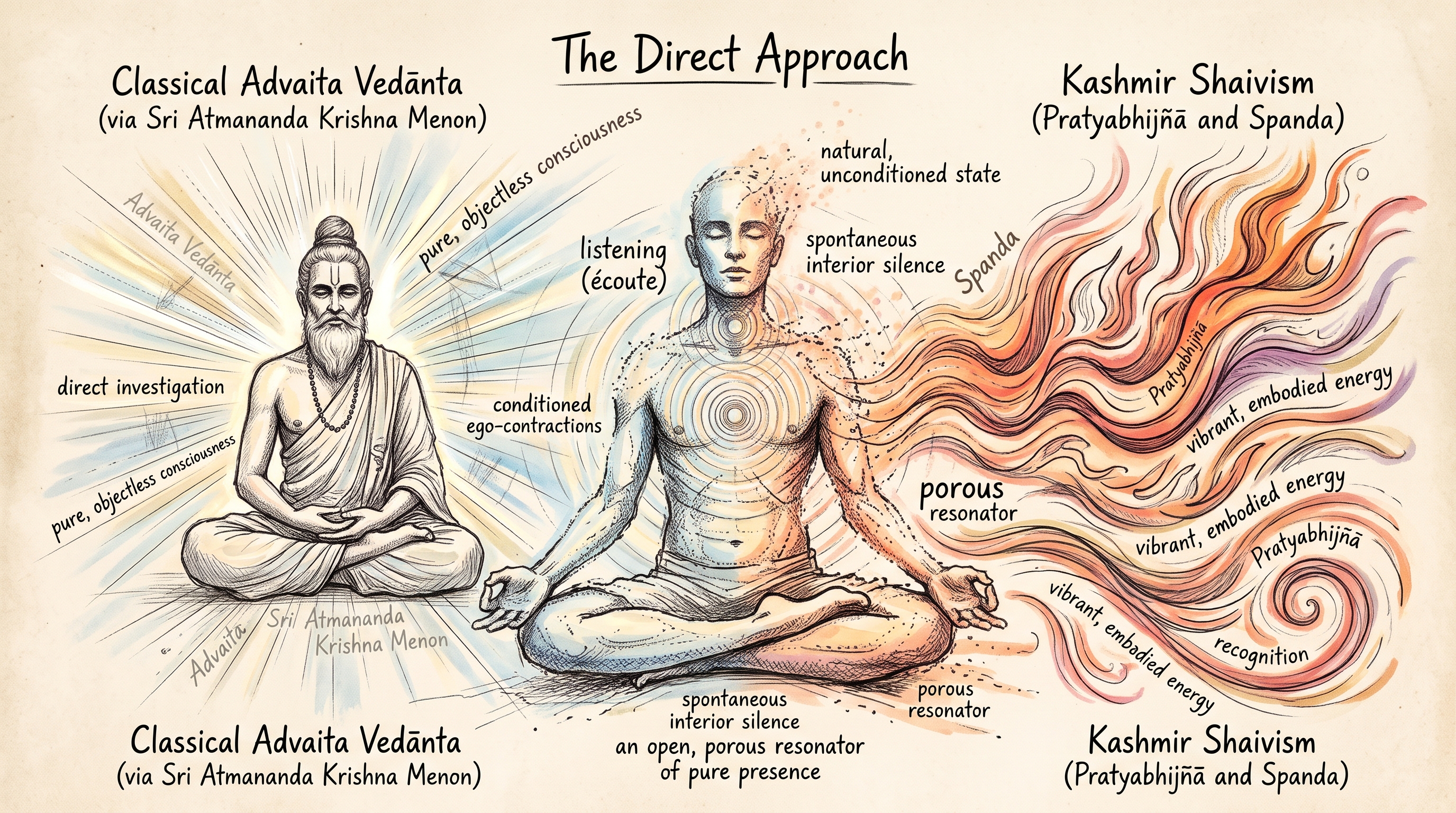
1. Lineage and Theoretical Foundations: The Marriage of Advaita and Kashmir Shaivism
Born in Berlin to a French-German family and raised in France, Jean Klein initially pursued formal disciplines in musicology and medicine in Vienna and Paris, exploring how acoustic vibration, harmonic intervals, and biological structures intersect with conscious perception. Facing deep existential questions following the devastation of World War II, Klein traveled to India in the early 1950s, immersing himself in the study of classical Indian philosophy and Sanskrit. In Bangalore, he met his spiritual preceptor, Pandit Veeraraghavachar (often referred to as "Panditji"), who instructed him in the Direct Approach of Advaita Vedānta while immersing him in the non-dual Tantric traditions of Kashmir Shaivism.
Following his realization on the banks of the Ganges, Klein returned to the West in 1960. Rather than adopting the exotic vestments, monastic dogmas, or institutional hierarchies of traditional Eastern institutions, he articulated non-duality through clean phenomenological language accessible to the Western mind, bridging ancient Eastern epistemology with Western somatic inquiry.
| Classical Advaita Vedānta (Direct Path) | Kashmir Shaivism (Pratyabhijñā & Spanda) |
|---|---|
| • Radical non-objective discrimination • The seer cannot be an object seen • Dissolution of the illusory "separate self" • Reality as silent, immutable awareness | • The world and body as expressions of divinity • Somatic energy (prāna) and subtle vibration • The senses as outward radiating light • Spontaneous tactile celebration of form |
Klein’s unique pedagogical contribution resides in his balance between two complementary perspectives:
- The Vedāntic Discernment (Viveka): The systematic deconstruction of false identification. By recognizing that whatever can be perceived—thoughts, emotional moods, sensations, outer objects—is an object of perception, the practitioner recognizes they are the invariant, uncreated subject rather than the observed object.
- The Kashmiri Tantric Embodiment: A profound rejection of world-denying asceticism. Instead of dismissing the material cosmos and physical flesh as mere illusion (māyā), Kashmir Shaivism treats physical sensation and bodily forms as dynamic, shimmering vibrations (spanda) of divine consciousness (Śiva-Śakti). Consciousness does not withdraw from the world; it recognizes itself as the very texture of lived experience.
| Philosophical Vector | Classical Shankaran Advaita | Kashmiri Shaivism (Pratyabhijñā) | Jean Klein's Direct Approach Synthesis |
|---|---|---|---|
| Ontological Status of the World | Mithyā (superimposed, provisional, unreal dream). | Prakāśa-Vimarśa (real, divine self-expression). | The world is recognized as consciousness itself appearing as form. |
| View of the Human Body | An ephemeral cage of karmic ignorance to be transcended. | A divine microcosm and tactile sacred instrument. | A transparent, musical resonator decontracted through sensory listening. |
| Primary Method | Intellectual negation (Neti, Neti — "Not this, not this"). | Aesthetic celebration, energetic alignment, recognition. | Direct resting in the witness; somatic release of muscular contractions. |
| Role of Volition | Ascetic discipline, renunciation, scriptural study. | Spontaneous recognition (pratyabhijñā) of latent divinity. | Choiceless awareness; abandonment of the seeker identity and goal-striving. |
2. The Direct Approach vs. The Progressive Path
The cornerstone of Jean Klein's teaching is his unyielding distinction between the Progressive Path (the gradual accumulation of spiritual merit, meditative control, and moral perfection) and the Direct Approach (immediate, non-teleological recognition of ever-present truth).
The Analogy of the Traveler and the Living Room
Consider an exhausted traveler who packs heavy suitcases, books passage across vast oceans, climbs treacherous mountain passes, and endures years of austere deprivation in search of a legendary sanctuary called "Home." Along the journey, the traveler acquires maps, studies foreign dialects, and submits to arduous training regimens.
One day, the traveler suddenly glances around and recognizes the wallpaper, the floorboards, and the warmth of the fireplace: they have never left their own living room. The entire journey was an elaborate dream funded by the false assumption of distance.
The progressive spiritual path is that endless journey of packing and traveling; the Direct Approach is simply opening one's eyes and recognizing that you are already sitting in the room you sought.
Klein explained that traditional meditative disciplines that train concentration, manage breath, or suppress wandering thoughts inevitably reinforce the very illusion they intend to shatter: the existence of a central controller or "seeker." When a practitioner sits down with the volitional intention to "become enlightened," they implicitly affirm two false premises:
- That liberation is an object situated in future time.
- That there exists a separate, autonomous entity ("I") who can perform actions to purchase that object.
Because reality is not a product of cause and effect, no progressive causal action can manufacture uncaused reality. Every movement of the will—every attempt to quiet the mind—is merely another vibration of the ego.
The Analogy of the Flashlight Seeking Darkness
Imagine a flashlight that develops a passionate curiosity to understand what total darkness looks like. With fierce determination, the flashlight scours every corner of a windowless basement, turning its high-intensity beam toward dark corners, behind support pillars, and into deep crevices.
Yet, no matter how quickly it turns or how intensely it shines, it can never find darkness—its very effort projects the light that banishes the shadow.
In Klein's framework, the ego searching for consciousness through effort, meditation, or willpower is identical to this flashlight. Every act of volition is an illumination of egoic grasping. Only when the flashlight ceases its frantic searching and runs out of battery does the underlying baseline reality effortlessly reveal itself.
| Diagnostic Dimension | The Progressive Path (Gradualism) | The Direct Approach (Jean Klein) |
|---|---|---|
| Epistemological Posture | The student is an ignorant seeker climbing toward enlightenment. | The individual is already the unconditioned truth; seeking conceals it. |
| Temporal Framework | Linear, teleological, future-oriented (awakening occurs later). | Immediate, timeless, vertical (awakening is the ground of the present). |
| Mechanism of Practice | Concentrative effort, mental suppression, behavioral refinement. | Effortless observation, choiceless listening, radical welcoming. |
| Role of the Ego | Trained, refined, purified, and eventually surrendered. | Recognized instantly as an episodic, non-continuous phantom object. |
| State of Mind Sought | Trance states (samādhi), sustained silence, empty mind. | Natural everyday awareness (sahaja), whether noisy or quiet. |
3. The Epistemology of "Listening" (Écoute) and Choiceless Awareness
Because Klein rejected volitional meditation techniques, his contemplative instruction focused almost exclusively on the cultivation of pure "listening" (écoute). Klein used this term not in the narrow auditory sense of registering acoustic vibrations with the physical ear, but as an open, global posture of receptive, choiceless attention.
The Analogy of the Ocean and the Waves
An anxious wave on the surface of the sea spends its brief life comparing its height to neighboring waves, fearing the inevitable moment it will crash against the rocky shore and perish. It consults older, wiser waves on how to achieve "ocean-hood," attempting to flatten itself or surge higher through tremendous effort.
Yet, the wave does not need to undergo a transformation to become water; water is its absolute, intrinsic substance from the moment it rises to the moment it falls.
"Listening" is the simple, non-conceptual realization of wetness. Thoughts, moods, and biological panics are merely temporary ripples on the surface of awareness; the ocean of pure consciousness remains infinitely undisturbed, unaffected by whether the surface exhibits a raging tempest or glass-like calm.
In ordinary life, the human mind operates as an organ of aggressive appropriation: whenever a thought, perception, or physical sensation arises, the ego immediately grasps it, tags it with a conceptual label, judges it as pleasant or unpleasant, and calculates how to retain or eradicate it. This perpetual habit of grabbing (grasping) maintains the subject-object divide.
Klein taught that when this habitual reflex is released, listening becomes non-directional and global:
- Listening Without an Object: You do not listen to something; you abide as listening itself.
- Welcoming Without Judgment: Perceptions are permitted to enter and exit without resistance. Klein described this welcoming as absolute benevolence—an unreserved "yes" to whatever is occurring within the sensory field.\n- Collapse of the Observer: In sustained, unmotivated listening, the supposed listener at the center dissolves. There is no longer an "I" hearing a "sound"; there is simply the unmediated event of hearing, revealing that the observer and the observed are composed of the identical conscious fabric.
| Dimension | Grasping / Conceptual Mind | Pure Listening (Écoute) / Choiceless Alertness |
|---|---|---|
| Directionality | Focused, selective, narrowing, exclusionary. | Panoramic, open, global, 360-degree receptivity. |
| Relationship to Content | Evaluates, categorizes, defends, seeks outcome. | Welcomes all phenomena without preference or resistance. |
| Energetic Signature | Muscular tension, frontal-lobe striving, focal contraction. | Somatic expansion, spacious relaxation, effortless presence. |
| Sense of Identity | Localized "I" residing behind the eyes peering out. | Boundaryless space of awareness in which sensations arise. |
4. The Kashmiri "Body Approach": Somatic Decontraction and the Musical Instrument
Unlike many intellectual exponents of Neo-Advaita who dismiss the physical body as an irrelevant illusion, Jean Klein placed immense emphasis on somatic exploration. Drawing on his medical training, his understanding of musical resonance, and his mastery of Kashmiri Tantric yoga, Klein recognized that psychological ego-identity is not merely an abstract mental belief; it is physically incarnated as chronic neuromuscular tension.
The Analogy of the Musician and the Strung Instrument
A master violin maker knows that if the wood of a violin is warped, knotted, or excessively rigid, the instrument cannot resonate; instead of amplifying pure, rich tones, it deadens the vibrations into dull thuds. Conversely, if the wood is properly cured, hollowed, and tension-free, the entire body of the violin sings in spontaneous resonance with the lightest touch of the bow.
The human body, in Klein's teaching, is designed to be an acoustic violin for pure consciousness. However, years of psychological trauma, defensive self-protection, and conceptual grasping warp the wood, freezing the muscles into chronic defense armoring. Through the "body approach," the knots of the instrument are gently softened through open awareness, transforming the body from a leaden bunker into an open, weightless chamber of vibration.
Klein observed that whenever the concept "I" is entertained, an involuntary physical contraction occurs—typically localized in the throat, chest, diaphragm, solar plexus, or pelvic floor. The ego is essentially an ongoing series of defensive physical contractions designed to protect a phantom identity against a threatening world.
Through subtle bodily awareness exercises conducted in silence, Klein guided students to deconstruct this defensive armor:
- Evocation of the Subtle Body: Moving attention away from the conceptual, anatomical image of the body (bones, organs, skin boundaries) and feeling the body strictly as pure, unlocalized tactile sensation.
- Dissolving Boundaries: When physical sensations are observed without conceptual projection, the perceived border between the "inside" of the body and the "outside" world begins to soften and dissolve. The body is experienced as a porous, cloud-like field of energy floating in spacious awareness.
- Weightlessness and Transparency: As chronic muscular contractions relax into space, the density of the physical form gives way to an experience of luminous transparency, where the body feels like an open spatial vibration rather than a heavy, solid object.
| 1. The Armored Body (Ego) | 2. Somatic Listening | 3. The Transparent Body |
|---|---|---|
| • Dense, localized, heavy • Clear inside/outside border • Chronic muscular defense knots • Reactionary and fearful | • Observing tensions without judgment or intent to fix • Tactile sensation without an anatomical mental map | • Expansive energy field • Boundaries dissolve • Porous resonator for pure consciousness |
| Trait | The Conditioned Physical Body | The Kashmiri "Subtle Body" (Klein's Body Approach) |
|---|---|---|
| Somatic Texture | Dense, opaque, localized, structurally rigid. | Porous, vibrating, luminous, weightless, spatial. |
| Spatial Boundary | Fixed perimeter defined by the epidermal skin. | Seamless continuum where internal sensation blends into space. |
| Psychological Function | Defensive fortress protecting the separate ego. | Transparent conductor expressing spontaneous presence. |
| Contemplative Stance | Object to be conquered, disciplined, or ignored. | Intimate tactile sensation welcomed into spacious silence. |
5. The Deconstruction of the "Controller" and the Seeker Identity
In modern philosophy of mind and contemplative psychology, one of the primary obstacles to direct realization is the persistent assumption of an internal executive agent—what contemporary cognitive science terms the central controller and what Gilbert Ryle famously attacked in the concept of the "ghost in the machine".
Klein conducted a relentless phenomenological deconstruction of this presumed inner manager. When we examine our immediate experience without presupposition, can we actually find an entity that originates thoughts, manages heartbeat, or directs attention?
The Analogy of the Cinema Screen and the Celluloid Projection
In a dark theater, an epic film projects onto the screen: a raging wildfire engulfs a forest, followed by a terrifying oceanic tidal wave that sweeps across coastal cities, followed by scenes of human grief and celebration. The spectators in the audience weep, cower, and cheer.
Yet, when the film ends and the lights illuminate the auditorium, the white canvas of the screen is completely unburned by the raging flames, completely dry after the catastrophic flood, and completely unblemished by the dramatic tragedies. The screen was the unmoving, impartial ground that permitted the light show to appear.
Klein taught that primal awareness is the screen. The drama of human life—including the character named "the seeker" striving for spiritual purity—is simply the moving projection. Awareness is never wounded by sorrow, never elevated by mystical visions, and never compromised by ignorance.
Klein pointed out that the "seeker" is merely the final, most sophisticated disguise assumed by the ego. Having exhausted worldly pleasures in material accumulation, career status, or romance, the ego simply rebrands its grasping impulses under spiritual terminology:
- It seeks enlightenment instead of money.
- It seeks mystical experiences instead of sensory thrills.
- It seeks moral purity instead of social prestige.
Yet, the functional architecture remains unchanged: an imaginary subject trying to acquire an external object in future time. True liberation does not occur when the seeker attains what it seeks; it occurs when the seeker is recognized as a fictitious conceptual construct and spontaneously collapses.
| Trait | The Illusory Ego-Controller | Primal Awareness (The Witness) |
|---|---|---|
| Continuity | Intermittent; disappears in deep sleep, fainting, or flow states. | Unbroken, immutable; present prior to, during, and after all states. |
| Activity | Compulsive doing, calculating, judging, defending. | Non-doing, effortless registering, choiceless allowance. |
| Spatial Locus | Imagined behind the eyes or within the cranial vault. | Non-localized; the infinite space in which coordinates appear. |
| Ontological Status | A rapid stream of conditioned memories and bodily sensations. | The unconditioned conscious ground that illuminates the stream. |
6. The Egalitarian Guru-Disciple Dynamic: Silence as Transmission
Jean Klein held a radical, profoundly egalitarian view of the teacher-student relationship that diverged sharply from the authoritarian, guru-worshiping models prevalent in traditional Eastern ashrams and contemporary Western cults.
The Analogy of the Two Tuning Forks
Imagine two identical tuning forks mounted on wooden resonance boxes. If you strike the first tuning fork so that it rings at 440 Hz, and then place it alongside the second silent tuning fork, the second fork begins to hum and vibrate at the identical frequency through acoustic resonance, without ever being touched.
Klein viewed the authentic teacher not as a master commanding a subordinate, but as a vibrating tuning fork resting in its natural ground state of silence. When the student sits in the presence of this non-grasping openness, their own internal agitation naturally subsides, and their consciousness spontaneously resonates with the shared silence.
For Klein, an authentic spiritual guide never adopts the psychological mask of "the enlightened teacher," nor do they project upon the visitor the degrading identity of "the ignorant student." Both identities are dualistic fictions:
- If a teacher believes they possess truth and the student lacks it, the teacher remains trapped in egoic pride.
- If a student believes the teacher possesses enlightenment as personal property, the student remains trapped in disempowered idolatry.
True teaching takes place in what Klein termed a "coming together"—a shared space of silence where dualistic identities vanish. The teacher acts merely as a mirror that clarifies the student's misconceptions until the student's grasping mind naturally runs out of momentum and discovers its own innate, unblemished nature.
| Dynamic | Authoritarian / Hierarchical Guru Model | Jean Klein's Egalitarian Model |
|---|---|---|
| Power Structure | Asymmetrical; guru holds supreme spiritual authority. | Symmetrical; absolute shared oneness in the space of awareness. |
| Student's Identity | Deficient, sinful, or unenlightened disciple. | The unconditioned reality itself, temporarily confused by concepts. |
| Pedagogical Goal | Obedience, guru-devotion, transmission of esoteric shakti. | Intellectual clarity, somatic relaxation, self-reliant recognition. |
| Resolution | Permanent institutional dependency on the guru's grace. | Dissolution of the dynamic into ordinary, autonomous presence. |
7. The Direct Path Lineage Transmission
Jean Klein’s synthesis of Advaita Vedānta and Kashmir Shaivism established the foundation for the contemporary Direct Path movement in the English- and French-speaking worlds. His transmission directly shaped a succession of prominent contemporary philosophers, psychotherapists, and non-dual authors.
| Lineage Tier | Teacher / Contemplative | Philosophical Emphasis & Approach |
|---|---|---|
| Root Source | Sri Atmananda Krishna Menon (1883–1959) | Classical Direct Path Advaita |
| Master Synthesizer | Jean Klein (1912–1998) | Advaita + Kashmiri Tantric Body Approach |
| First Generation Successors | Francis Lucille (1944–Present) | Direct Path Phenomenological Dialectic |
| Eric Baret (Contemporary) | Kashmiri Yoga & Tantric Somatics | |
| Second Generation Successors | Rupert Spira | Idealist Non-Duality & Tactile Translucency |
| Stephen Bodian | Integrated Somatic Zen & Non-Dual Psychotherapy |
| Successor / Lineage Figure | Core Heritage from Jean Klein | Distinctive Contribution / Modern Evolution |
|---|---|---|
| Francis Lucille | Pure Direct Path inquiry; mathematical clarity; Kashmiri yoga. | Rigorous epistemic dialectic; transmission to leading Western teachers. |
| Rupert Spira | Somatic exploration of the body; experiential deconstruction of objects. | Phenomenological idealism; the transparency of experience; artistic craft. |
| Stephen Bodian | Somatic listening (écoute); deconstruction of the seeker identity. | Integrating direct non-duality with Western psychotherapy and Soto Zen. |
| Eric Baret | Kashmiri Shaivism (Spanda); subtle bodily posture and breath. | Preservation of the non-volitional, poetic Kashmiri Tantric yoga tradition. |
🎴 Interactive Web Practice (Comprehension Check)
Question 1 (The Direct Approach vs. Progressive Paths): Why did Jean Klein assert that progressive spiritual techniques and concentrative practices paradoxically push the seeker further away from liberation?
Answer: Jean Klein argued that progressive spiritual paths are inherently teleological and cause-and-effect oriented: they treat enlightenment as a future object to be attained through linear effort, mental concentration, or moral purification. However, because our true nature (pure consciousness or primal awareness) is uncaused, eternal, and already fully present as the background witness of all experience, it cannot be produced by any action of the will.
When a practitioner employs effort to "reach" truth, they subconsciously reinforce the primary illusion of dualism: the existence of an autonomous, separate "seeker" manipulating mental states. As illustrated by the analogy of the flashlight searching for darkness, every movement of volition merely casts another ray of egoic grasping, concealing the effortless silence that is already our natural state.
Question 2 (The Somatic "Body Approach" & Kashmir Shaivism): How does Klein's treatment of the physical body diverge from classical Shankaran Advaita, and what role does "listening" (*écoute*) play in unwinding somatic conditioning?
Answer: While classical Shankaran Advaita often adopts a world-denying posture that dismisses the body as an illusory, karmic cage (*mithyā*), Klein drew upon Kashmir Shaivism (Pratyabhijñā and Spanda) to treat the body as a sacred, dynamic manifestation of divine consciousness. Klein recognized that psychological ego-identity is physically incarnated as chronic neuromuscular tensions and defensive holding patterns.
Rather than trying to force the body into rigid meditative postures or suppress physical sensation, Klein taught the art of "listening" (écoute). By resting attention in the tactile sensations of the body without conceptual labels or anatomical mental pictures, these muscular defense knots naturally unwind. The body is transformed from a dense, armored bunker into a transparent, weightless musical instrument that vibrates in open harmony with spatial awareness.
Question 3 (The Egalitarian Guru Dynamic): How did Jean Klein deconstruct the traditional authoritarian guru-disciple hierarchy, and what occurs during what he termed a "coming together"?
Answer: Jean Klein rejected the hierarchical guru-disciple relationship, asserting that if a teacher maintains an image of themselves as an "enlightened master" and views the student as an "ignorant pupil," both parties remain trapped in dualistic projection.
In Klein's egalitarian view, an authentic teacher acts like a struck tuning fork: resting firmly in their natural vibration of silence without personal claims or psychological agendas. During a "coming together," teacher and student meet without projected identities or power dynamics. In this shared openness, the student's agitated grasping mind naturally quiets, discovering that the teacher's silence and the student's inner reality are identical, uncreated consciousness.
Backlinks
- Ralph Waldo Emerson — Klein's Direct Approach—the insistence that reality is immediately accessible without institutional, ritual, or sacerdotal mediation—directly parallels Emerson's Transcendentalist doctrine of self-reliance and the sacred Oversoul. Both thinkers maintain that truth is an immediate, intuitive fact of consciousness rather than a historical or doctrinal acquisition.
- The Core Instruction - Turning the Gaze Inward — Klein's somatic and attentional instruction to "look for the looker" and relax into global listening provides the direct operational mechanics for this contemplative guide. Both deconstruct the subject-object dichotomy by collapsing the illusory vantage point of the central observer.
- William James & William James and the Landscape of Eastern Thought — James's seminal psychological distinction between "sciousness" (pure, immediate awareness prior to egoic ownership) and "con-sciousness" (reflective, ego-tagged mental processing) serves as an exact Western philosophical correlate to Klein's "primal awareness" versus conditioned conceptual thought.
- Rupert Spira — Direct lineage successor through Francis Lucille; Spira inherited Klein's Kashmiri somatic inquiry and effortless phenomenological observation, evolving Klein's French-Sanskrit synthesis into a contemporary idealist philosophy of non-dual consciousness.
- Stephen Bodian — Studied directly with Klein in the 1980s; adopted Klein's somatic listening and deconstruction of the "seeker identity," subsequently synthesizing Klein's Direct Path with classical Soto Zen monasticism and Western somatic psychotherapy.
- Deconstruction of the Central Controller — Klein's experiential dismantling of the inner manager mirrors contemporary cognitive science and phenomenological critiques that reveal the executive "self" to be an episodic conceptual fiction rather than a continuous biological commander.
- Gilbert Ryle's-The Concept of Mind — Ryle’s philosophical critique of the Cartesian "ghost in the machine" provides an analytical Western foil to Klein's contemplative dismantling of the localized ego-agent hiding inside the skull.
Resonant Notes
The following notes in the vault share direct thematic, contemplative, and philosophical connections with Jean Klein's Direct Approach and nondual phenomenology:
🔴 Non-Dual Awareness, Direct Path & Contemplative Lineages
- Rupert Spira — Preeminent direct lineage successor in the contemporary West; carries forward Klein’s somatic exploration of the body, the deconstruction of the separate self, and the recognition of consciousness as the sole, non-objective fabric of experience.
- Stephen Bodian — Direct student of Klein who received formal dharma transmission from Adyashanti (born Steven Gray, 1962); synthesizes Klein’s somatic listening and rejection of spiritual striving with Western emotional integration and non-dual psychotherapeutic practice.
- Adyashanti (born Steven Gray, 1962) — Contemporary American non-dual teacher who mirrors Klein’s radical critique of spiritual striving and meditative contrivance; emphasizes effortless resting, natural presence (sahaja), and the collapse of the identity of the seeker.
- Dzogchen — Tibetan Vajrayāna tradition of the "Great Perfection"; shares Klein’s subitist (sudden) orientation, asserting that primordial awareness (rigpa) is already fully enlightened and ever-present, requiring direct recognition rather than progressive cultivation through karmic cause and effect.
- Anam Thubten — Contemporary Tibetan contemplative whose core teaching of "effortless resting" (gom-me) and radical dismantling of spiritual ambition directly reflects Klein’s Direct Approach and critique of progressive meditative engineering.
- Perennial Philosophy & Aldous Huxley's The Perennial Philosophy — Comprehensive taxonomic hubs documenting Advaita Vedānta and non-dual mysticism across cultures, articulating the foundational premise that the individual soul (Ātman) and universal ground (Brahman) are identical.
- Traditional vs. Secular Buddhist vs. General Spiritual Teachers — Primary pedagogical matrix classifying spiritual instructors; places Klein prominently within the "General / Eclectic Spiritual Teacher" paradigm characterized by post-traditional authority, direct phenomenological transmission, and cross-cultural synthesis.
🟡 Somatic Presence, Embodiment & The Mind-Body Division
- The Mind-Body Dichotomy — Direct philosophical bridge examining how dualistic traditions artificially sever consciousness from somatic matter; features Klein's synthesis of Kashmir Shaivism and Advaita as a prime model of "Luminous Non-Duality" that dissolves Cartesian estrangement through tactile awareness.
- Constructs of the Mind-Unmasking Consciousness in East and West — Exhaustive philosophical treatise contrasting Buddhist Madhyamaka, Yogācāra, and Advaita Vedānta; analyzes how the deconstruction of grasping (grāhya-grāhaka) unveils the background field of unified, unconstructed awareness central to Klein's framework.
- Eckhart Tolle — Popular contemporary contemplative whose emphasis on "the Now," the cessation of the psychological clock, and the somatic anchoring in the "inner body" (subtle body) popularized key elements of Klein's Kashmiri somatic approach for mass audiences.
- Jon Kabat-Zinn — Pedagogical counterpart; contrasting Kabat-Zinn's gradual, clinically structured mindfulness protocol (MBSR) with Klein’s unconditioned, immediate recognition of the ever-present observer.
🟢 Western Phenomenology, Consciousness Studies & Transcendentalism
- William James & William James and the Landscape of Eastern Thought — James's radical empiricism, critique of the dualistic spectator theory of knowledge, and formulation of "sciousness" directly parallel Klein’s phenomenology of primal awareness resting prior to mental categorization.
- Ralph Waldo Emerson & American Transcendentalism — 19th-century American forebears of Western non-dual intuition; Emerson's rejection of historical theological mediation in favor of direct, unmediated communion with the Oversoul anticipates Klein's post-traditional Direct Approach.
- Henri Bergson — French philosopher whose concept of durée (pure duration) and critique of spatialized clock-time illuminate Klein’s rejection of psychological evolution; both assert that reality is a living, indivisible continuum that cannot be captured by discrete intellectual snapshots.
- Husserl's Internal Time-Consciousness — Phenomenological analysis of retention, primal impression, and protention; clarifies Klein's insight regarding the "gap between two thoughts," demonstrating that the temporal flow of conceptual objects is illuminated by a non-temporal horizon of awareness.
- Gilbert Ryle's-The Concept of Mind & Philosophy of Mind — Modern philosophical diagnostics deconstructing Cartesian dualism; provide the Western analytical machinery to validate Klein's experiential claim that the internal "ego-thinker" is a linguistic category mistake.
- Deconstruction of the Central Controller — Neuro-phenomenological inquiry mapping how the brain's default mode network manufactures the illusion of a centralized pilot, corroborating Klein’s teaching that internal stillness unmasks the absence of an executive ego.
References
Eric Baret on Vedantic & Tantric elements in Jean Klein's teaching
This discussion by a former student offers valuable context on how Jean Klein synthesized the traditions of Advaita Vedanta and Kashmiri Tantra.